

Some links on this page are affiliate links. If you buy through one, Planet 3DP earns a small commission at no extra cost to you. It never changes what we recommend. How this works. As an Amazon Associate I earn from qualifying purchases.
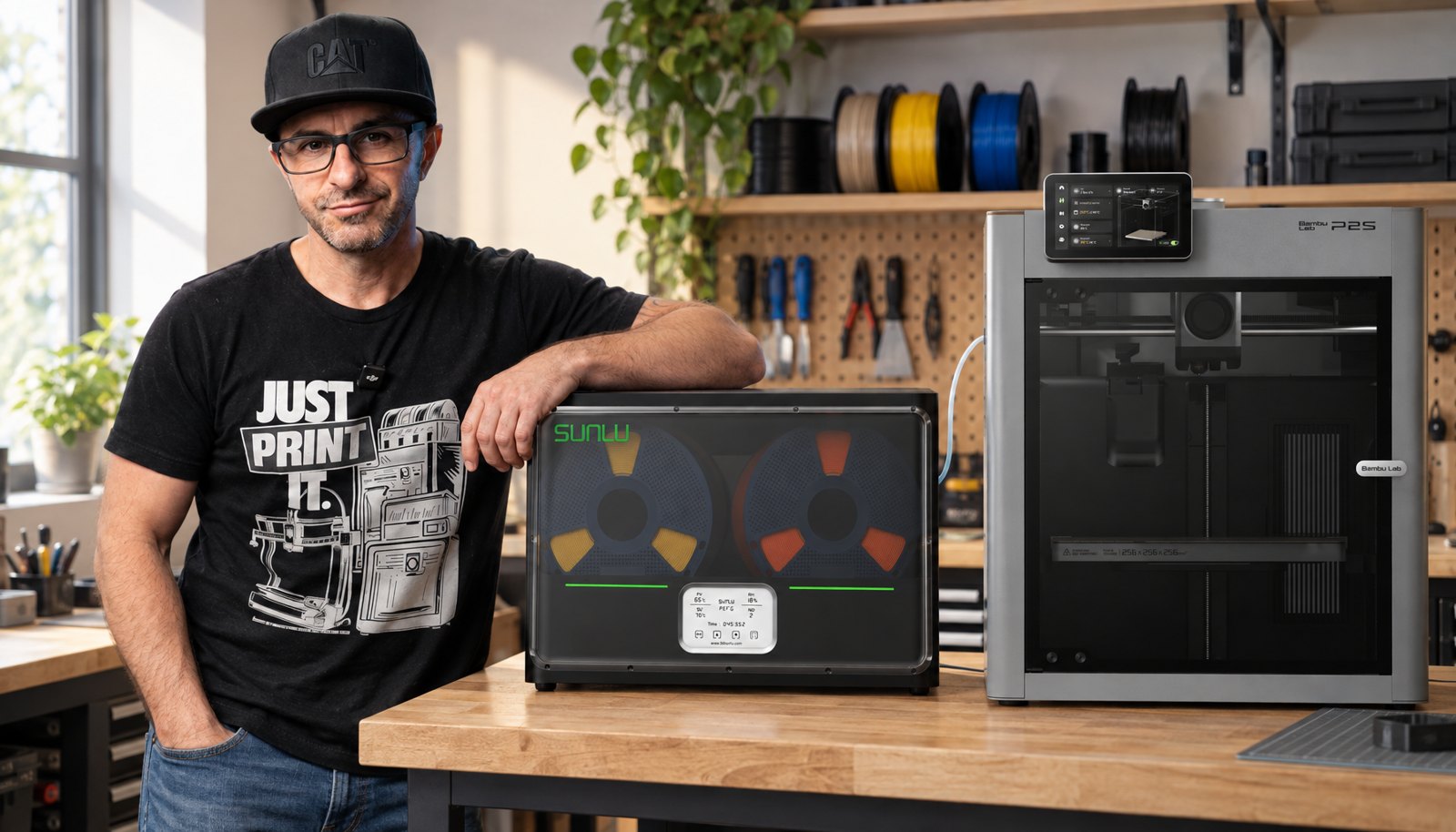
The best filament dryer for most people who run more than one printer is the SUNLU FilaDryer S4. It’s the one Nick uses. It holds four spools, heats to 70°C, starts and stops on its own humidity reading, and feeds printers straight out of the box. The other picks below are chosen by job and labelled honestly: Nick hasn’t used them, so every figure comes from the maker’s own page.
A dryer fixes the stringing, blobs and rough walls that wet filament causes. If you aren’t sure that’s your problem yet, the wet filament section of our print problems guide shows what it looks like.
- Nick uses
- SUNLU FilaDryer S4, 116.99 dollars at SUNLU’s store. Four spools, up to 70°C.
- Hotter materials
- SUNLU FilaDryer S4 Pro, 139.99 dollars. Four spools, up to 85°C, two heat zones.
- Nylon and carbon fibre
- SUNLU FilaDryer E2, 249.99 dollars. Two spools, up to 110°C.
- Cheapest
- SUNLU FilaDryer S2, 44.99 dollars. One spool, up to 70°C.
- Two spools under 100 dollars
- Creality Space Pi V2 Plus, 89 dollars. Up to 75°C.
- Bambu Lab owners
- Bambu Lab AMS HT, 139 dollars. One spool, up to 85°C, feeds the AMS chain.
Store prices from each maker’s own store, read by the Planet 3DP price tracker on October 26, 2026. Specs from the makers’ own pages. Only the S4 is on Nick’s bench. Live prices are on our filament and dryer deals page.
Buying direct from SUNLU? Use code MRNGB2VN5D at checkout for a discount.
The best filament dryers in 2026
Seven picks, each one for a different job. The first is on Nick’s bench. The EIBOS is one he has used before. The rest are picked from their specs and say so.
SUNLU FilaDryer S4
Nick uses this. Best if you run more than one printer.
- In his tools video at 4:58 Nick picks it for anyone who wants every spool dried and ready at the same time.
- Four spools at once, up to 70°C, with a 99 hour timer.
- A humidity sensor starts and stops drying by itself, so you can leave it running.
- Filament feeds out of the box to the printers while it dries.
- SUNLU sends Nick filament to test.
116.99 dollars at SUNLU’s store (139.99 before the markdown), store price checked October 26, 2026
SUNLU S4 at SUNLUSUNLU FilaDryer S4 Pro
Not tested by Nick. The four spool box for ABS, ASA and nylon.
- Four spools, up to 85°C, with two independent heat zones.
- Humidity mode starts drying at a level you set and stops by itself.
- Feeds the printer while drying, like the S4.
- SUNLU sends Nick filament to test.
139.99 dollars at SUNLU’s store, store price checked October 26, 2026
SUNLU S4 Pro at SUNLUSUNLU FilaDryer E2
Not tested by Nick. For nylon, PC and carbon fibre blends.
- Up to 110°C, the hottest dryer on this page.
- Two spools, a humidity readout and a 99 hour timer.
- Feeds the printer while drying, with PTFE tubes in the box.
- SUNLU sends Nick filament to test.
249.99 dollars at SUNLU’s store (349.99 before the markdown), store price checked October 26, 2026
SUNLU E2 at SUNLUSUNLU FilaDryer S2
Not tested by Nick. The cheapest dryer here.
- One spool, up to 70°C, with a humidity readout on the screen.
- The spool turns on a roller, and you can print straight out of it.
- 80.99 dollars buys two, one for each of two printers.
- SUNLU sends Nick filament to test.
44.99 dollars at SUNLU’s store (79.99 before the markdown), store price checked October 26, 2026
SUNLU S2 at SUNLUCreality Space Pi V2 Plus
Not tested by Nick. Two spools for under 100 dollars.
- Two spools, up to 75°C, with a temperature and humidity sensor.
- 48 hour timer and a PTFE tube to feed the printer.
- Spools sit on a roller system inside the box.
89 dollars at Creality’s US store, store price checked October 26, 2026
Space Pi V2 Plus at CrealityBambu Lab AMS HT
Not tested by Nick. For Bambu Lab owners who print hot materials.
- One spool, up to 85°C, and the spool turns while it dries.
- Joins the AMS chain, so the dried spool feeds the printer directly.
- It has to be connected to the printer to dry, and runs off its own power adapter, which is in the box.
139 dollars for one unit at Bambu Lab’s US store, store price checked October 26, 2026
AMS HT at Bambu LabEIBOS Polyphemus
Nick has used this. Two spools that turn on their own.
- In his A1 mods video Nick used one to keep his queued spools, PETG included, dry and ready.
- Two spools, up to 80°C, with a motor that rotates them while they dry.
- Humidity readout and a timer that runs up to 24 hours or without a limit.
- The model on sale now is EIBOS’s upgraded 2026 version, and these specs are for that one.
Buying direct from SUNLU? Use code MRNGB2VN5D at checkout for a discount.
Filament dryers compared
Thirteen dryers on one table. Read across for spools and heat first, because those two decide which materials and how many printers a box can keep up with.
| Dryer | Spools | Max heat | Feeds a printer | Store price | Nick |
|---|---|---|---|---|---|
| SUNLU S4 | 4 | 70°C | Yes | 116.99 dollars | Nick uses this |
| SUNLU S4 Pro | 4 | 85°C | Yes | 139.99 dollars | Not tested |
| SUNLU E2 | 2 | 110°C | Yes | 249.99 dollars | Not tested |
| SUNLU SP2 | 2 | 70°C | Yes | 69.99 dollars | Not tested |
| SUNLU S2 | 1 | 70°C | Yes | 44.99 dollars | Not tested |
| Creality Space Pi V2 Plus | 2 | 75°C | Yes | 89 dollars | Not tested |
| Creality Space Pi V2 | 1 | 75°C | Not stated | 84.90 dollars | Not tested |
| Bambu Lab AMS HT | 1 | 85°C | Yes, through the AMS | 139 dollars | Not tested |
| Elegoo H1 HT | 1 | 85°C | Yes | 70 dollars | Not tested |
| EIBOS Polyphemus | 2 | 80°C | Yes | Amazon only | Nick has used this |
| Polymaker PolyDryer | 1 | 73°C | Yes | 79.99 dollars | Not tested |
| Snapmaker SnapDryer | 1 | Not stated (3 power levels) | Yes | 71.99 dollars | Not tested |
| Eryone Snail M2 | 1 | 55°C | Yes | 69.99 dollars | Not tested |
Do you need a filament dryer?
Bambu Lab only marks drying as recommended for PLA, not required, so a printer that only runs PLA in a dry room can get by for a while. Bambu Lab’s own guide puts typical indoor air at 45 to 65% relative humidity, and says most filament only stays dry for a while when it’s stored below 20%.
At around 55%, Bambu Lab says freshly dried filament takes in enough water to hurt print quality within 2 to 12 hours, depending on the material. That’s why a spool that printed fine last month starts stringing in a damp week.
Nick found this out in Arizona, where you’d think it would never matter. His family ran humidifiers at night, and he started seeing blobs in his infill and layers that didn’t line up. The problem went away once the humidifiers stopped running near his office. That story is in his A1 mods video.
Some materials aren’t optional. Bambu Lab marks drying before use as required for TPU, PC, PVA and nylon blends, and recommended for PLA Basic, PETG, ABS and ASA. If any of the first group is on your shelf, buy a dryer.
How hot does a filament dryer need to get?
This is the spec that decides most of the choice. Bambu Lab’s drying chart for a fan oven asks for 50°C for PLA and 60 to 65°C for PETG. ABS, ASA, PC and the nylon carbon fibre blends sit at 75 to 85°C. The high temperature engineering filaments go from 100 to 140°C.
So a 70°C box like the S4, S2 or SP2 covers PLA and PETG with room to spare. Nick says the S4’s 70°C covers everything from PLA up to nylon and PC. Bambu Lab’s chart asks for more than that for those last two, so if ABS, PC or nylon is most of what you print, an 85°C dryer like the S4 Pro, the AMS HT or the Elegoo H1 HT gives you headroom.
Only the SUNLU E2 on this list reaches 110°C. Buy it if carbon fibre nylons are your main material, not just in case.
| Material | Fan oven | AMS 2 Pro | AMS HT |
|---|---|---|---|
| PLA Basic | 50°C | 45°C | 45°C |
| PETG | 60 to 65°C | 65°C | 65°C |
| TPU 85A and 90A | 70°C | 65°C, may not fully dry | 75°C |
| ABS and ASA | 75 to 85°C | Not compatible | 80°C |
| PC | 75 to 85°C | Not compatible | 80°C |
| Nylon carbon fibre blends | 75 to 85°C | Not compatible | 85°C |
Follow the spool first. If the label on your filament gives a drying temperature, use it. The chart numbers are Bambu Lab’s for its own filament.
Does the AMS 2 Pro dry filament well enough?
For PLA and PETG, it does a real job. Bambu Lab rates the AMS 2 Pro’s drying at up to 65°C, with the spools turning as they dry and RFID matching the settings for Bambu’s own filament. Its chart runs PLA at 45°C and PETG at 65°C, 12 hours each.
There are three catches, all on Bambu Lab’s own product page. The 65°C is only reached when the room is above 25°C. Bambu Lab says the AMS 2 Pro can’t fully dry ABS, ASA, PET, nylon or PC, and recommends the AMS HT for those. And it can’t dry on its own: it has to be connected to the printer, and A1, P1 and X1 owners need a Switching Adapter for each unit. The H2, P2 and X2D printers can power one unit for drying without it.
Bambu Lab’s FAQ also says an AMS that is part of the running print can’t dry at the same time, while units that aren’t in the current job can. The same FAQ says certain models now support drying and printing at once, with the details in its wiki.
So for a Bambu Lab owner, the AMS HT is the natural step up for hot materials. For PLA and PETG across several printers, a standalone box like the S4 dries four spools without tying up an AMS.
Match the spool count to your printers
One printer running one material is fine with a single box like the S2 or the PolyDryer. Two printers want two spools. Nick’s reason for the S4 is that it keeps every spool dried and ready at the same time across several machines.
Feeding matters as much as capacity. Every dryer in the table except the Space Pi V2 is listed as able to feed a printer while it runs, and that’s how you keep nylon or TPU dry through a long print. Once a dried spool sits in room air, Bambu Lab’s 2 to 12 hour clock starts.
A second option is several single boxes. Two S2 boxes are 80.99 dollars and the SnapDryer dock with four boxes is 119. Two S2 boxes also give you two separate temperature settings.
Keep it dry after the dryer
Drying is half the job. Bambu Lab says dried filament should go into a sealed container or an AMS with desiccant, and that even at 20% humidity most spools stay dry for only 2 to 7 days.
For spools waiting their turn, Nick uses a BIQU Panda Feed Rack, which he shows in his tools video. It keeps them off the floor and easy to grab across several printers and materials. It’s an open steel rack, so it’s for organising, not for keeping water out.
For sealing, he has a short on EIBOS vacuum bags, which he calls the fastest way to store filament. The EIBOS bag pack is ten bags, and the pump isn’t included.
The rest of the field
None of these are on Nick’s bench. Here’s who each one suits, from the makers’ own specs.
SUNLU SP2 at 69.99 dollars is a heating base under a storage box for two spools, up to 70°C. Good if you want the box to double as storage.
Creality Space Pi V2 at 84.90 dollars is the one spool version of the V2 Plus. At 89 dollars for the two spool Plus, the Plus is the easier buy.
Elegoo H1 HT at 70 dollars reaches 85°C for one spool, the cheapest 85°C box here. Elegoo doesn’t mention a humidity readout.
Polymaker PolyDryer at 79.99 dollars and the Snapmaker SnapDryer at 71.99 dollars are each a heated dock with a separate spool box. The PolyDryer tops out at 68 to 73°C by Polymaker’s own figure.
Eryone Snail M2 at 69.99 dollars tops out at 55°C on fixed presets of up to 5 hours. That’s fine for PLA and not much more.
The rest of Nick's bench The S4 is one of the tools Nick uses every day. His one page list has the rest.
Get the tools listFilament dryer questions
What is the best filament dryer?
For anyone running more than one printer, the SUNLU FilaDryer S4. It’s the one Nick uses: four spools, up to 70°C, humidity controlled, and it feeds printers while it dries. It was 116.99 dollars at SUNLU’s store on October 26, 2026. For nylon and carbon fibre, the SUNLU E2 reaches 110°C.
Do I need a filament dryer for PLA?
Bambu Lab recommends drying PLA before use rather than requiring it. In a typical room at around 55% humidity it says dried filament can take on enough water to affect prints within 2 to 12 hours, so if you see stringing or rough walls, dry the spool first.
What temperature should I dry filament at?
Follow the spool label first. Bambu Lab’s oven chart gives 50°C for PLA, 60 to 65°C for PETG and 75 to 85°C for ABS, ASA, PC and nylon carbon fibre blends.
Can you print straight out of a filament dryer?
Yes, with most of them. The S4, S4 Pro, E2, S2, SP2, Space Pi V2 Plus, H1 HT, PolyDryer, SnapDryer and Eryone M2 all feed the printer through a hole or a PTFE tube. Bambu’s AMS units feed through the AMS, but can’t dry a spool that the current print is using.
Is the AMS 2 Pro a filament dryer?
Partly. It dries at up to 65°C, which Bambu Lab says suits PLA and PETG, but it can’t fully dry ABS, ASA, PET, nylon or PC. Bambu Lab recommends the AMS HT, which reaches 85°C, for those.
Is the SUNLU S4 worth it?
Nick’s view in his tools video is that it’s a great option for most people, and worth looking at if you run several printers and want every spool ready at once. SUNLU sends Nick filament to test. The S4 itself is the dryer he uses.
- Planet 3DP video: New 3D Printer? Don't Start Without These Tools (April 2026), the SUNLU S4 at 4:58 and the BIQU rack at 5:42 (checked October 26, 2026)
- Planet 3DP video: Essential A1 3D Printer Mods! (January 2025), the EIBOS dryer at 4:36 (checked October 26, 2026)
- Bambu Lab Wiki: Drying filament, the material chart and storage humidity notes (checked October 26, 2026)
- Bambu Lab US store: AMS 2 Pro drying temperature, compatibility and FAQ (checked October 26, 2026)
- Bambu Lab US store: AMS HT drying temperature and FAQ (checked October 26, 2026)
- SUNLU store: FilaDryer S4 (checked October 26, 2026)
- SUNLU store: FilaDryer S4 Pro (checked October 26, 2026)
- SUNLU store: FilaDryer E2 (checked October 26, 2026)
- SUNLU store: FilaDryer S2 (checked October 26, 2026)
- SUNLU store: FilaDryer SP2 (checked October 26, 2026)
- SUNLU blog: FilaDryer S4 analysis (spool rollers) (checked October 26, 2026)
- Creality store: Space Pi V2 Plus (checked October 26, 2026)
- Creality store: Space Pi V2 (checked October 26, 2026)
- Elegoo US store: H1 HT dryer box (checked October 26, 2026)
- Snapmaker US store: SnapDryer (checked October 26, 2026)
- Snapmaker Wiki: SnapDryer quick start guide (checked October 26, 2026)
- Polymaker Wiki: PolyDryer (checked October 26, 2026)
- Polymaker store: PolyDryer product page and FAQ (checked October 26, 2026)
- Eryone store: Snail Dryer Box M2 product page and FAQ (checked October 26, 2026)
- EIBOS official shop: Polyphemus data sheet (checked October 26, 2026)
- Planet 3DP price tracker: store prices for 12 of the 13 dryers, read on each maker's own US store (checked October 26, 2026)

Host of Planet 3DP. I have been 3D printing for over four years, with tens of thousands of print hours across Bambu Lab, Anycubic, Creality, Elegoo and Snapmaker machines. The SUNLU S4 on this page is the dryer on my bench. Planet 3DP on YouTube.
Last checked October 26, 2026.