

Updated October 26, 2026. Rebuilt with print temperatures for every common filament type, a PLA temperature table from four makers’ data sheets, and Nick’s notes from his engineering filament test.
Some links on this page are affiliate links. If you buy through one, Planet 3DP earns a small commission at no extra cost to you. It never changes what we recommend. How this works.
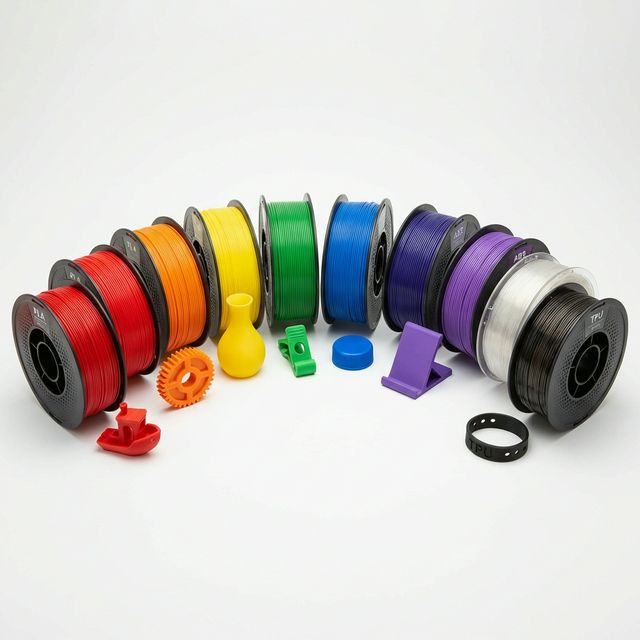
The 3D printer filament types you’ll meet are PLA, PETG, ABS, ASA and TPU, then nylon, polycarbonate and versions of most of them filled with carbon or glass fiber. PLA is the one to start with. The rest each do a job PLA can’t, and most of those jobs need a hotter nozzle, a hotter bed or an enclosed printer.
Every temperature on this page comes from the material maker’s own table or data sheet, with the date it was checked. Most of them are from Bambu Lab‘s material table, which covers every type below in one place. The notes on nylon, ASA, polycarbonate and TPU are from Nick’s own test of every engineering filament he owns.
- Most prints
- PLA. The easiest to print, and it runs on any printer.
- Heat, sun or knocks
- PETG. Tougher and more heat resistant than PLA, no enclosure needed.
- Hot parts
- ABS, or ASA if the part lives outdoors. Both need an enclosed printer.
- Flexible parts
- TPU. Soft and rubbery. Keep it out of the AMS.
- Engineering parts
- Nylon or polycarbonate, dried first, in an enclosed printer.
- Choosing between PLA, PETG and ABS
- Our PLA vs PETG vs ABS guide settles that three way choice.
Temperatures and printer requirements from Bambu Lab’s material table and the Bambu Lab, Polymaker, SUNLU and Prusament data sheets, checked October 26, 2026.
3D printer filament types at a glance
One row per type. The nozzle range is Bambu Lab’s, and Bambu says it holds give or take 10°C. Your own spool’s data sheet wins if it says something different.
| Filament | Nozzle | Bed | Enclosed printer | Hardened nozzle | Dry before use |
|---|---|---|---|---|---|
| PLA | 190 to 240°C | 35 to 65°C | Not needed | No | Recommended, 55°C for 8 h |
| PLA with carbon or glass fiber | 210 to 240°C | 35 to 65°C | Not needed | Yes | Recommended, 55°C for 8 h |
| PETG | 240 to 270°C | 60 to 80°C | Not needed, but helps in a cold room | No | Recommended, 70°C for 8 h |
| PETG HF (high flow) | 230 to 260°C | 60 to 80°C | Not needed | No | Required, 65°C for 8 h |
| TPU (flexible) | 200 to 250°C | 30 to 45°C | Not needed | No | Required, 70°C for 8 h |
| ABS | 240 to 280°C | 90 to 100°C | Yes | No | Recommended, 80°C for 8 h |
| ASA | 240 to 280°C | 90 to 100°C | Yes | No | Recommended, 80°C for 8 h |
| PC (polycarbonate) | 260 to 290°C | 100 to 120°C | Yes | No | Required, 80°C for 8 h |
| Nylon with carbon or glass fiber | 260 to 300°C | 100 to 120°C | Yes | Yes | Required, 80°C for 8 to 12 h |
Plain nylon isn’t in Bambu’s nozzle table, so check the spool. SUNLU’s Easy PA, the nylon Nick used in his test, lists 250 to 270°C at normal speeds and a 30 to 50°C bed with glue.
How the types compare on heat, knocks and pulling
Bambu Lab rates each material out of five rather than publishing one number. The stars only compare these materials with each other.
| Filament | Heat | Impact | Pull strength |
|---|---|---|---|
| PLA | 2 of 5 | 2 of 5 | 3 of 5 |
| PLA with carbon fiber | 2 of 5 | 2 of 5 | 4 of 5 |
| PETG | 3 of 5 | 3 of 5 | 2 of 5 |
| ABS | 3 of 5 | 3 of 5 | 3 of 5 |
| ASA | 3 of 5 | 3 of 5 | 3 of 5 |
| PC | 4 of 5 | 4 of 5 | 4 of 5 |
| Nylon (PA) | 4 of 5 | 3 of 5 | 4 of 5 |
| Nylon with carbon or glass fiber | 5 of 5 | 2 of 5 | 5 of 5 |
| TPU | 1 of 5 | 5 of 5 | 1 of 5 |
PLA (polylactic acid)
PLA is the default for a reason. Bambu Lab’s data sheet calls it the most common material in 3D printing because it’s easy to print and cheap. Bambu lists it as not prone to warping, with no mandatory temperature needs, so it prints on an open frame machine like the Bambu Lab A1 as happily as on an enclosed one.
Its weak spot is heat. Bambu says PLA isn’t recommended where it sits at about 50°C or more, because it can slowly soften and deform. Its own PLA Basic sheet puts the heat deflection temperature at 54°C. Prusa gives a temperature resistance of 55°C for Prusament PLA. So a PLA part on a car dashboard in summer is asking for trouble.
It’s stronger than people think in one way. Bambu rates PLA 3 of 5 for pull strength and PETG only 2. It’s stiff and a bit brittle, so it resists a straight pull and loses to a hammer. The full comparison is in PLA vs PETG vs ABS.
PLA print temperature by brand
There’s no single right PLA temperature. Each maker tunes its own blend, and the ranges below come straight from their own sheets. Start in the middle of your spool’s range, then go hotter if you print faster.
| PLA | Nozzle | Bed | Drying |
|---|---|---|---|
| Bambu Lab PLA Basic | 190 to 230°C | 35 to 45°C | 50°C for 8 h |
| Polymaker PolyLite PLA | 190 to 230°C | 25 to 60°C | 55°C for 6 h |
| SUNLU PLA+ 2.0 | 205 to 215°C up to 100 mm/s, 215 to 245°C at 100 to 200 mm/s | 50 to 60°C | 50°C |
| Prusament PLA | 210°C, give or take 10 | 40 to 60°C | Not usually needed |
Two things stand out. SUNLU ties its temperature to speed: the faster you print, the higher its range. And the makers disagree on drying. Bambu’s own PLA Basic sheet says 50°C for 8 hours while its material table says 55°C for 8 hours for PLA in general.
Bambu’s wider PLA range of 190 to 240°C in the first table covers every PLA it lists, including silk and matte. For one spool, the range on its own label is the better guide.
Stringing? Bambu Lab lists damp filament as the first cause. Dry the spool before you blame the temperature.
PETG (polyethylene terephthalate glycol)
PETG is the next step up. Bambu lists 240 to 270°C on a 60 to 80°C bed. It rates 3 of 5 for heat and impact against PLA’s 2, so it’s the usual pick for parts that live outside, hold water or get knocked about.
It doesn’t need an enclosure. Bambu does recommend one if the room is cold, because low air temperature weakens the bond between layers. PETG also strings more than PLA, and it soaks up moisture. Bambu marks drying as recommended for normal PETG and required for PETG HF, the high flow version, which also wants desiccant with it while it prints.
ABS (acrylonitrile butadiene styrene)
ABS takes heat and knocks, and it’s the material that needs the most care. Bambu lists 240 to 280°C on a 90 to 100°C bed. It lists ABS as not recommended on an open frame printer and recommended on an enclosed one, because it needs a hot bed and a hot chamber to stop warping and layers splitting. It’s also not recommended in the AMS lite.
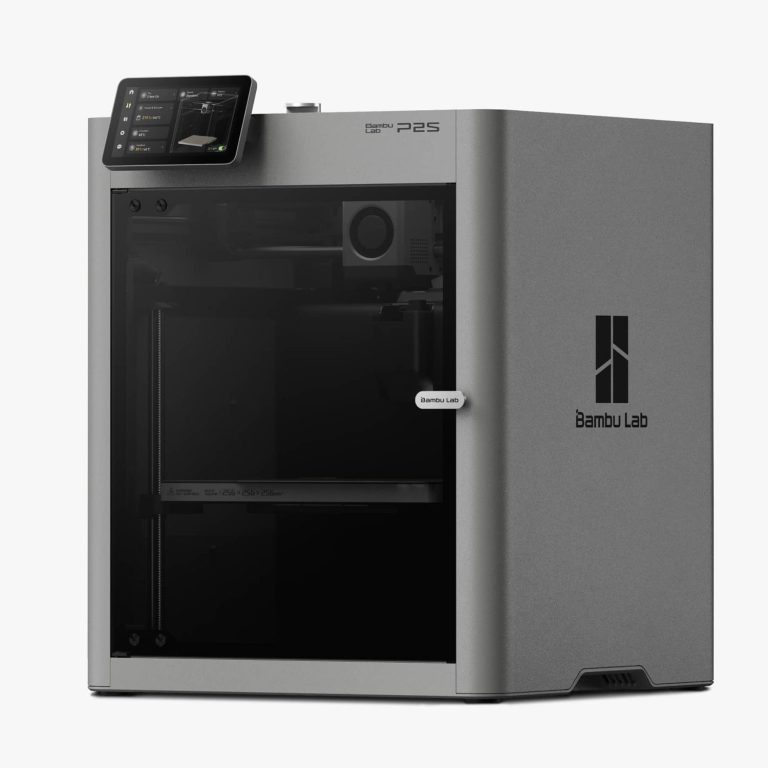
If you print on an enclosed machine like the Bambu Lab P2S, ABS is open to you.
Open frame printer? PETG gets you the same 3 of 5 heat and impact ratings as ABS on Bambu’s scale, with no enclosure needed.
ASA, the outdoor version of ABS
ASA prints at the same 240 to 280°C and 90 to 100°C bed as ABS, needs the same enclosure, and scores the same on Bambu’s scale. The difference is the weather. In his engineering filament test, Nick puts it simply at 5:21: ASA is basically ABS that survives outside. That’s why it ends up on outdoor prints and car parts.
TPU, the flexible one
TPU is rubber you can print. It bends, bounces and grips, and it tops Bambu’s impact scale at 5 of 5 while scoring 1 for heat and pull strength. Bambu lists 200 to 250°C on a cool 30 to 45°C bed, and marks drying as required.
The catch is feeding it. Bambu lists standard TPU as not compatible with the AMS and AMS lite, because filament that soft can’t pass smoothly through the feed channel. Bambu does sell one TPU named for the job, TPU for AMS. Nick learned this the hard way on his Bambu Lab X2D.
Nylon (PA) and polycarbonate (PC)
These are the engineering filaments. Bambu rates nylon 4 of 5 for heat and pull strength and polycarbonate 4 of 5 across the board. Both need an enclosed printer, a 100 to 120°C bed and a dry spool. Bambu marks drying as required for both, at 80°C for 8 hours or more.
Nylon is the one to watch for moisture, as Nick says above. If you want an easier start, Nick calls SUNLU’s Easy PA nylon with training wheels: low warp, no cracking, and it prints cooler than the rest. Polycarbonate runs at 260 to 290°C, and as Nick says, it warps hardest of all.
Engineering parts often need supports, and the support material matters more than you’d think. Nick tested two support materials against every engineering filament he owns, and the right pick flips from one to the next. His results are in the X2D engineering filament test.
Printing engineering filament?Nick’s free pairing guide lists every engineering filament with the support material to run against it.
Get the free guideWatch: every engineering filament on the X2D
- 0:00Which support peels cleanest?
- 0:12The setup
- 2:25Nylons: Sunlu EZ PA
- 2:45Nylons: PA12 with carbon fiber
- 3:15Nylons: PA6 with glass fiber
- 3:45Nylons: PA6 with carbon fiber
- 5:38ABS and PC: ASA
- 6:42ABS and PC: ABS with glass fiber
- 7:00ABS and PC: PC and ABS blend
- 7:26ABS and PC: PC, the trade off
- 8:59Bonus round: TPU
- 11:11The final cheat sheet
Carbon fiber and glass fiber filaments
Most types come in a version filled with chopped carbon or glass fiber. The fiber makes parts stiffer, as Nick found with the glass filled ABS in his test. On Bambu’s scale it lifts nylon to 5 of 5 for heat and pull strength, and drops its impact score to 2.
The fiber also wears out soft nozzles. Bambu requires a hardened steel nozzle for these grades and says never to use a 0.2 mm nozzle with them, because the clog risk is too high. Its first choice is a 0.6 mm hardened nozzle, with 0.4 mm as the second choice for finer detail. Rough filaments can also wear the feed tubes inside an AMS over time.
Specialty filaments
Silk, matte, metal, wood and marble PLAs print in the PLA range, between 190 and 240°C, and sell on looks. A few have rules of their own. Bambu says wood and marble PLA can’t go through a 0.2 mm nozzle, and glow in the dark PLA needs a hardened nozzle. Its nozzle guide also suggests hardened steel for marble and sparkle PLA, which carry hard particles.
Support materials are the other specialty group. Bambu marks PVA drying as required, and says damp PVA or BVOH is too soft for the AMS. Bambu also sells Support for PLA and Support for ABS, and Nick’s X2D test shows which one peels cleanest from each engineering filament.
Which filament types can your printer run?
This settles it for most people before strength does. Bambu splits its own printers into open frame and enclosed, and rates each filament for both.
| Filament | Open frame printer | Enclosed printer | AMS / AMS lite |
|---|---|---|---|
| PLA, PLA silk, matte and metal | Fine | Fine | Fine |
| PETG | Fine | Fine | Fine |
| TPU | Fine | Fine | Not compatible |
| ABS | Not recommended | Recommended | AMS fine, AMS lite not recommended |
| ASA | Not recommended | Recommended | Fine |
| PC | Not recommended | Recommended | Fine |
| Nylon with carbon or glass fiber | Not recommended | Recommended | Bambu’s own PA and PAHT carbon fiber only |
Dry it before you blame the printer
Every filament takes in water from the air. Bambu explains what happens next: the water turns to steam in the hot nozzle, the melted plastic forms bubbles, and you get stringing, under extrusion, holes, rough surfaces and weaker parts. Its advice is simple. If you aren’t sure a spool is dry, dry it, and keep it sealed with desiccant while it prints.
Nick found this out in Arizona, of all places. In his A1 mods video at 4:36 he explains that humidifiers running at home put blobs in his infill and made his layers uneven. The problem went away once he stopped running them near his office. He now keeps his most used spools, like PETG, in a dryer.
Bambu marks drying as required, not just recommended, for PETG HF, TPU, PC, nylon and PVA. The fix guide covers the symptoms in our wet filament section, and current dryer prices are on our dryer deals list.
Where to buy
Nick prints on Bambu Lab and SUNLU filament. SUNLU sends Nick filament to test. Live store prices for these and other spools are on our filament deals page.
Buying direct from SUNLU? Use code MRNGB2VN5D at checkout for a discount.
Filament type questions
What are the main types of 3D printer filament?
The everyday types are PLA, PETG, ABS, ASA and TPU. The engineering types are nylon (PA), polycarbonate (PC) and versions of most types filled with carbon or glass fiber. Specialty PLAs such as silk, matte, wood and glow, and support materials such as PVA, complete the list.
What temperature should I print PLA at?
Use your spool’s own range and start in the middle. Bambu Lab lists 190 to 230°C for PLA Basic, Polymaker 190 to 230°C for PolyLite PLA, Prusament 210°C give or take 10, and SUNLU 205 to 245°C for PLA+ 2.0 depending on speed. Print faster, print hotter.
What do PLA, PETG and ABS stand for?
PLA is polylactic acid. PETG is polyethylene terephthalate glycol. ABS is acrylonitrile butadiene styrene.
Which 3D printer filament is the strongest?
On Bambu Lab’s own scale, nylon and PET filled with carbon or glass fiber score highest for heat and pull strength, 5 of 5. Plain polycarbonate scores 4 of 5 for heat, impact and pull. For impact alone, flexible TPU tops the scale at 5 of 5.
Which filaments need an enclosed printer?
Bambu Lab lists ABS, ASA, PC, nylon and their fiber filled versions as not recommended on an open frame printer. PLA, PETG and TPU print fine without an enclosure, though Bambu suggests one for PETG in a cold room.
Do I need a hardened steel nozzle?
Only for filament filled with carbon fiber, glass fiber or other hard particles. Bambu Lab requires one for those grades and for glow in the dark PLA. For plain PLA, PETG, ABS, ASA, PC and TPU, Bambu lists a hardened nozzle as not required.
What is the best filament for beginners?
PLA. It prints cooler than most types, Bambu Lab lists it as not prone to warping, and it runs on any printer without an enclosure. Add PETG when a part needs more heat resistance or toughness.
Can TPU go through a Bambu Lab AMS?
Bambu Lab lists standard TPU as not compatible with the AMS and AMS lite because it’s too soft to feed. Nick forced generic TPU through an AMS 2 Pro and it bound in the PTFE tubes. He runs TPU from an external spool, or suggests Bambu’s TPU for AMS.
Watch Planet 3DP on YouTubeNew printers, slicer updates and hands on tests every week.
Subscribe- Bambu Lab Wiki: Filament guide material table (nozzle and bed temperatures, printer, nozzle and AMS compatibility, drying, heat, impact and tensile ratings) (checked October 26, 2026)
- Bambu Lab: PLA Basic technical data sheet V3.0 (checked October 26, 2026)
- Bambu Lab Wiki: Stringing and oozing (causes, damp filament first) (checked October 26, 2026)
- Bambu Lab US store: PLA Basic (data sheet link) (checked October 26, 2026)
- Polymaker Wiki: PolyLite PLA recommended printing conditions (checked October 26, 2026)
- Polymaker Wiki: PolyLite PLA technical data sheet (checked October 26, 2026)
- SUNLU store: PLA+ 2.0 specifications (checked October 26, 2026)
- SUNLU store: Easy PA specifications (checked October 26, 2026)
- Prusament: PLA material page (printer requirements) (checked October 26, 2026)
- Prusa online shop: Prusament PLA technical parameters (checked October 26, 2026)
- Planet 3DP video: I Tested Every Engineering Filament on the Bambu X2D (July 2026), nylon at 1:52, Easy PA at 2:24, ASA at 5:21, PC at 7:02, TPU at 8:25 (checked October 26, 2026)
- Planet 3DP video: Essential A1 3D Printer Mods (January 2025), filament moisture at 4:36 (checked October 26, 2026)

Host of Planet 3DP. I have been 3D printing for over four years, with tens of thousands of print hours on Bambu Lab, Anycubic, Creality, Elegoo and Snapmaker machines. The temperatures on this page are the makers’ published figures. The nylon, ASA, PC and TPU notes are from my own engineering filament test on the X2D. Planet 3DP on YouTube.
Last checked October 26, 2026.