

Some links on this page are affiliate links. If you buy through one, Planet 3DP earns a small commission at no extra cost to you. It never changes what we recommend. How this works.
Resin or filament? For most people, a filament (FDM) printer is the one to start with. It’s cheaper to run, prints bigger parts and needs no chemicals. Add a resin printer when you want detail filament can’t reach, like miniatures, faces and fine textures. That’s also Nick’s answer after printing the same model both ways.
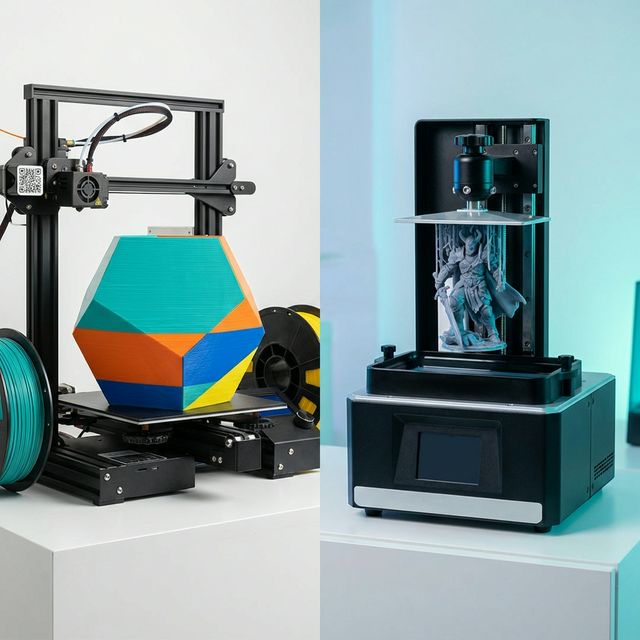
Filament printers melt a plastic strand and lay it down one layer at a time. Resin printers use UV light to harden liquid resin, layer by layer, which is why they capture far finer surface detail. Our best resin 3D printers guide has our picks, and the resin 3D printers page lists every resin machine in the directory.
- Verdict
- Start with filament. Add resin for detail work like miniatures and display pieces.
- Detail
- Resin wins clearly. In Nick’s test it caught skin texture and tooth ridges the FDM print couldn’t.
- Cost per print
- Filament wins. 7 dollars of PLA against about 48 dollars of resin in Nick’s test.
- Size and strength
- Filament wins for big and functional parts.
- Mess and safety
- Filament. Resin needs gloves, isopropyl alcohol, ventilation and curing.
From Nick’s resin vs FDM video, linked below, and the makers’ own pages, checked October 27, 2026.
Resin vs filament 3D printer: side by side
| Filament (FDM) | Resin (MSLA) | |
|---|---|---|
| How it prints | Melts plastic filament through a nozzle | Cures liquid resin with UV light |
| Detail | Visible layer lines, even at fine settings | Very fine, smooth surfaces |
| Build size | Larger. The A1 prints 256 mm cubes | Smaller. The Reflex is 191 x 121 x 220 mm |
| Material cost | 13.99 to 17.99 dollars per kilo of PLA | 18.99 to 23.99 dollars per kilo of resin |
| After printing | Snap off supports and you’re done | Wash, cure, then remove supports |
| Safety gear | None for PLA | Nitrile gloves, mask, goggles, ventilation |
| Good for | Functional parts, big models, everyday prints | Miniatures, collectibles, jewellery style detail |
Nick printed the same model both ways
Nick avoided resin for years because of the chemicals, the cleanup and the workflow. Then he tried the HeyGears Reflex. HeyGears sent Nick the Reflex and its wash and cure stations. He printed the same Star Wars Rancor once on the Reflex and once on his Bambu Lab A1 filament printer.
To keep it practical he ran the A1 with its standard 0.4 mm nozzle at its finest 0.08 mm layers. A 0.2 mm nozzle would have pushed the print past 150 hours. He explains why at 1:19.
| Same Rancor model | Resin, HeyGears Reflex | Filament, Bambu Lab A1 |
|---|---|---|
| Print time | 41 hours | 90 hours |
| Material cost | About 48 dollars of resin | About 7 dollars of PLA |
| Support removal | 30 minutes | 15 minutes |
| Extra work | Split into 4 parts, about 20 minutes washing and curing each | None |
| Detail | Skin texture, tooth ridges and claws | Visible layer lines |
The resin print showed individual bumps and wrinkles in the skin that disappeared on the FDM version, and each tooth ridge came out sharp. That’s at 1:51.
The resin also felt different. HeyGears’ PAF10 resin gave a slightly flexible finish, while the FDM print lost teeth during support removal and his daughter broke a chain off its arm. On the other hand the resin print took twice as long to clean up, though it left fewer scars. Support removal is at 8:19.
What each costs to run
| Material | Kind | Price per kilo | Store |
|---|---|---|---|
| Elegoo PLA | Filament | 13.99 dollars | Elegoo |
| Bambu PLA Basic | Filament | 17.99 dollars | Bambu Lab |
| Elegoo ABS Like Resin V3.0+ | Resin | 18.99 dollars | Elegoo |
| Anycubic Standard Resin V2 | Resin | 23.99 dollars (list 34.99) | Anycubic |
Filament is cheap. Elegoo’s PLA was 13.99 dollars a kilo and Bambu’s PLA Basic 17.99 when we checked. Resin was 18.99 a kilo for Elegoo’s ABS Like resin and 23.99 for Anycubic’s standard resin. Then resin adds isopropyl alcohol, gloves and usually a wash and cure station, such as Elegoo’s Mercury Plus V3.0 at 109 dollars.
Nick’s own math on one model was 48 dollars of resin against 7 dollars of filament. Worth it for a close up display piece, he says, and maybe not for larger or purely functional models.
Resin safety in short
Elegoo’s own resin guide says to wear nitrile gloves, a mask, safety goggles and an apron, to work in a well ventilated space away from UV light, to wash prints in 95% or stronger isopropyl alcohol, and to protect your eyes while curing. PLA on an FDM printer needs none of that. Read Elegoo’s guide.
Which one should you buy?
Choose a filament printer if it’s your first printer, if you print functional parts or big models, or if you don’t want chemicals in the house. The Bambu Lab A1 was 299 dollars when we checked, and our beginner printers guide has Nick’s picks.
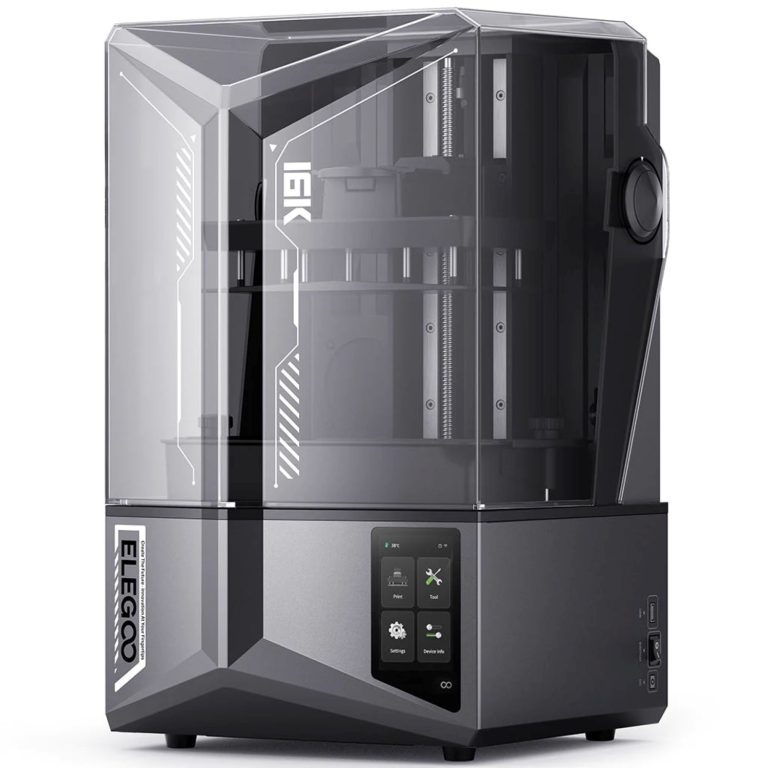
Choose a resin printer if you paint miniatures, print collectibles or need the finest surface detail, and you have a ventilated space for it. The Elegoo Saturn 4 Ultra 16K was 399 dollars (list 649.99). It’s not tested by Nick.
Or both. Nick keeps the Reflex for detailed parts of his 55 inch Star Destroyer and prints the big pieces on filament. Many makers end up with one of each.
Resin vs filament questions
Is resin or filament better for a first 3D printer?
Filament, for most people. It’s cheaper to run, needs no chemicals and prints larger parts. Nick’s verdict is that the Bambu Lab A1 is still the practical everyday choice for most makers.
Is resin printing more detailed than FDM?
Yes. In Nick’s test the resin print showed skin texture, tooth ridges and claws that the FDM print at 0.08 mm layers could not reproduce.
Is resin more expensive than filament?
Usually. We checked PLA at 13.99 to 17.99 dollars a kilo and resin at 18.99 to 23.99, and resin also needs isopropyl alcohol and gloves. Nick’s resin print cost about 48 dollars against 7 for PLA.
Is resin printing safe?
With precautions. Elegoo’s guide calls for nitrile gloves, a mask, goggles and an apron, good ventilation away from UV light, and eye protection while curing.
What is the difference between FDM and resin 3D printing?
FDM melts plastic filament through a nozzle and builds layer by layer. Resin printers cure liquid resin with UV light, which gives much finer detail but needs washing and curing afterwards.
- Planet 3DP video: I Printed The Same Model Two Ways, HeyGears Reflex (May 2025) (checked October 27, 2026)
- Bambu Lab: A1 technical specifications (checked October 27, 2026)
- HeyGears US store: Reflex specifications (checked October 27, 2026)
- Elegoo: Get Started in Resin Printing (safety) (checked October 27, 2026)
- Bambu Lab US store: A1 price (checked October 27, 2026)
- Elegoo US store: Saturn 4 Ultra 16K price (checked October 27, 2026)
- Planet 3DP price tracker: filament, resin and wash station prices (checked October 27, 2026)

Host of Planet 3DP. I print on filament every day and keep a resin printer for the detailed parts. Planet 3DP on YouTube.
Last checked October 27, 2026.