

Updated October 27, 2026. Bambu Lab’s Black Friday sale runs from October 27 to December 1, 2026. Its sale page, checked October 26, lists the X2D AMS Combo at 789 dollars and the P2S Combo at 649. That puts the two Combos 140 dollars apart. The other prices on this page are the prices we checked on October 15.
Some links on this page are affiliate links. If you buy through one, Planet 3DP earns a small commission at no extra cost to you. It never changes what we recommend. How this works.
These two Bambu Lab printers look the same from the outside and cost 100 dollars apart. The X2D has a second nozzle. That is the whole difference, and whether it is worth paying for comes down to one question: do your prints need supports? Nick ran the same part on both machines and weighed what each one threw away.
- The short answer
- Buy the X2D if you print organic shapes with heavy supports. Buy the P2S if you do not
- Price difference
- 100 dollars at the base machine, 150 dollars if you compare the two Combo versions
- X2D
- 649 dollars, or 899 as the AMS Combo
- P2S
- 549 dollars, or 749 as the Combo
- What the second nozzle buys
- Support interface material with no purge waste, so supports peel off and the surface underneath needs no cleanup
- Measured on one part
- The P2S took 3 hours 11 minutes longer and binned 59.69 g of filament. The X2D binned none
Prices read off Bambu Lab’s own US store on October 15, 2026. Each figure names its variant, because a Combo ships with the AMS multicolour unit and costs more.
- 0:00 The support removal difference
- 0:35 What is actually different
- 2:00 Price breakdown
- 2:40 How the dual nozzle works
- 4:00 Nozzle switching with zero purge
- 5:00 P2S print results
- 6:00 X2D print results
- 7:30 The real filament cost math
- 9:00 Full spec comparison
- 10:00 Filament Track Switch
- 11:00 X2D vs H2D for a print farm
- 12:00 Which should you buy
- 13:20 Final verdict
What is actually different
Same footprint, same top speed, same ecosystem, same material range on the main nozzle. The X2D adds a second nozzle, and the two are built differently on purpose.
The left nozzle is a direct drive motor in the tool head, with a short filament path and tight pressure control. That is the one that prints your model. The right nozzle is an auxiliary extruder whose motor sits at the back of the printer and pushes filament down a PTFE tube. Bambu split them that way to keep weight off the tool head, which means less vibration and better control.
The trade is speed. The auxiliary nozzle caps at 200 mm per second against 1,000 mm per second on the main one. For support interface layers that barely matters, because the interface is a thin fraction of the model.
Switching between the two is mechanical, with gears and triggers. Bambu says it tested the mechanism past a million switches. The part that matters for this comparison: when the X2D changes nozzles, nothing is purged.
The test, and what it cost in filament
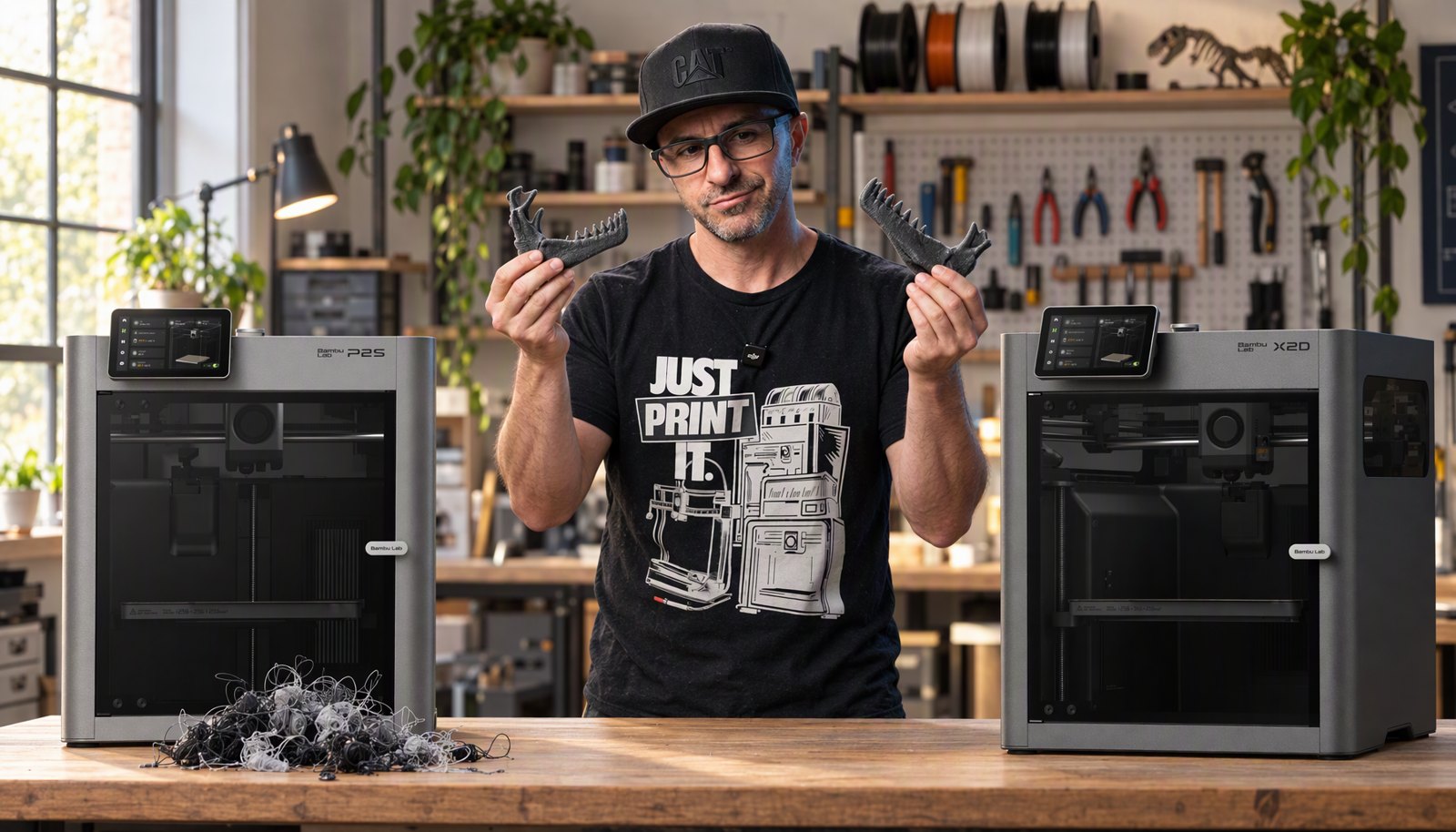
Nick printed the same lower jaw from a Dilophosaurus skull on both machines. Same model, same slicer, same settings. PETG for the model on both, with PLA interface layers on the supports, because PLA against PETG is what lets a support release cleanly.
On the P2S that job runs through one nozzle, so every switch from PETG to PLA and back is a full filament change with a full purge. On a part covered in tree supports, those switches are constant.
| Same jaw part, same settings | Bambu Lab P2S | Bambu Lab X2D |
|---|---|---|
| Nozzles | One | Two |
| Print time | 7 hours 25 minutes | 4 hours 14 minutes |
| Total filament | 148.55 g | 96 g |
| Purge waste | 59.69 g | 0 g |
| Cleanup under the supports | Abrasions to sand | None |
The purge figure is the one worth sitting with. 59.69 g of the 148.55 g that went through the P2S never became part of the model. That is about 40 percent of the filament, gone, on a single jaw. The X2D printed the same part with no purge at all, finished more than three hours sooner, and came off the plate ready for paint.
None of this is a fault in the P2S. It is what one nozzle doing two jobs looks like.
Does the second nozzle pay for itself
Nick put PETG at about 13 dollars a roll in the video, which works out near 1.3 cents a gram. On that one jaw, the 59.69 g the P2S purged is about 78 cents of filament thrown away before the print came off the bed.
At that rate the 100 dollar price difference is covered after roughly 129 prints of that same part. A full Dilophosaurus or Tyrannosaurus skull is more than a hundred parts, which is why he puts the payback inside the first couple of big projects rather than years out.
Two cautions. That is his own estimate from running a Tyrannosaurus skull across single nozzle machines, not a slicer readout, and he says so. And it only holds if you actually print with support interface material. If you run same material supports and live with the surface, the P2S wastes nothing extra and the maths never starts.
Worth knowing: Bambu PLA Basic refill was 15.99 dollars a kilo on Bambu’s own store on October 15, 2026. Filament prices move, so run the sum again with whatever you actually pay.
Side by side on the specs
| Spec | Bambu Lab P2S | Bambu Lab X2D |
|---|---|---|
| Price, base machine | 549 dollars | 649 dollars |
| Price with the AMS | 749 dollars as the Combo | 899 dollars as the AMS Combo |
| Nozzles | One | Two |
| Build volume | 256 by 256 by 256 mm | 256 by 256 by 260 mm |
| Main nozzle top speed | 1,000 mm per second | 1,000 mm per second |
| Auxiliary nozzle | None | 200 mm per second |
| Chamber heating | Passive, around 60 degrees | Active, 65 degrees |
| Enclosure and filtration | Fully enclosed, three stage | Fully enclosed, three stage |
| AMS 2 Pro support | Yes | Yes |
Everything else is shared. Both run Bambu’s current calibration stack, both use servo extruders with hardened steel gears and nozzles, both do AI print monitoring, and both stay under 50 decibels. Surface quality on the model itself is the same on each. The difference shows up only where a support was touching.
If chamber heat is the thing you want from the X2D rather than the nozzle, note that there is a P2S upgrade for that. Both machines handle ABS and ASA as they ship.
The print farm argument
Nick makes a case in the video for buying two X2Ds instead of one flagship. The numbers he used were April’s, so here they are again at today’s prices.
| What you could buy instead | Price on October 15, 2026 |
|---|---|
| Two Bambu Lab X2D, both dual nozzle | 1,298 dollars |
| One Bambu Lab H2D, the flagship | 1,549 dollars |
| The difference | 251 dollars, in favour of the pair |
Two dual nozzle machines running two separate jobs therefore come in under a single H2D.
The X2D is not an H2D. The build volume is smaller, there is no laser module, and the H2D carries more sensors. But for PETG models with PLA support interfaces, two machines beat one on throughput for less money.
The Filament Track Switch
Out of the box the X2D feeds each nozzle separately. Model filament goes in one side, support filament in the other. To run more colours or more materials you would need a second AMS unit.
Bambu has since released a routing module that lets one AMS feed both nozzles, switching which side gets fed on demand. Nick notes it does not change his own setup, where PETG sits on the left and PLA supports on the right. It matters if you want more than two materials without buying another AMS.
Which should you buy
Buy the P2S if support removal is not what hurts. Multicolour PLA and PETG, functional parts, toys, anything where the surface under a support does not need to be perfect. It is 100 dollars less, it is just as fast, and its DynaSense extruder handles carbon fibre and glass fibre filament well.
Buy the X2D if you print organic geometry. Skulls, creatures, figurines, anything with heavy tree supports where post processing is real work. The extra 100 dollars buys a setup where supports fall off and the contact surface is finished.
If you are genuinely torn, the time saved is the tiebreaker. Three hours and eleven minutes on one small part, plus no sanding afterwards, repeats on every print you make.
Free side by side comparison chart Nick put both machines on one sheet you can check while you shop. No cost, sent straight to your inbox.
Get the free PDFCommon questions
What is the difference between the Bambu Lab P2S and the X2D?
The X2D has two nozzles and the P2S has one. Everything else is close to identical: same footprint, same 1,000 mm per second top speed, same enclosure, same AMS 2 Pro support and the same material range on the main nozzle. The second nozzle lets the X2D lay down support interface material without purging filament to switch.
Is the X2D worth 100 dollars more than the P2S?
It depends on whether you use support interface material. On one jaw print the P2S purged 59.69 g of filament, worth about 78 cents at the 13 dollars a roll Nick quotes for PETG. At that rate the 100 dollar difference is covered after roughly 129 prints of that part. If you run same material supports instead, the P2S wastes nothing extra and the X2D premium buys you nothing.
Can the P2S print PLA support interfaces?
Yes, through the AMS. The cost is purge waste. With one nozzle, every switch from PETG to PLA and back is a full filament change, and on that measured jaw print the purge came to 59.69 g of the 148.55 g used, about 40 percent of the total.
How much do the P2S and X2D cost?
On Bambu Lab’s own US store on October 15, 2026, the P2S is 549 dollars and the X2D is 649 dollars. The versions that ship with the AMS multicolour unit are 749 dollars for the P2S Combo and 899 dollars for the X2D AMS Combo. Watch which version a price refers to, because the headline figure on Bambu’s page is whichever variant is preselected.
Does the X2D heat its chamber?
Yes, actively, to 65 degrees. The P2S heats passively through the bed and hot end and gets to around 60 degrees. Both handle ABS and ASA as they ship, and there is a separate P2S upgrade if active chamber heating is what you are after.
Is the X2D as good as the H2D?
No, and it is not meant to be. The H2D has a bigger build volume, an optional laser module and more sensors. The X2D takes the dual nozzle part of that machine down to 649 dollars. At today’s prices two X2Ds cost 251 dollars less than one H2D.
- Bambu Lab US store: X2D variant list and specs, 649 dollars base and 899 dollars AMS Combo (checked October 15, 2026)
- Bambu Lab US store: P2S variant list and specs, 549 dollars base and 749 dollars Combo (checked October 15, 2026)
- Bambu Lab US store: H2D list price, used for the print farm comparison (checked October 15, 2026)
- Bambu Lab US store: PLA Basic refill price per kilo (checked October 15, 2026)
- Planet 3DP video: X2D vs P2S, I Tested Both and the Numbers Don't Lie, 17 April 2026. Print times, filament weights, purge waste and the support removal results (checked October 15, 2026)

Host of Planet 3DP. I run a print farm of Bambu Lab machines and have logged well over 10,000 hours on P1S printers alone. Both machines on this page are ones I have printed the same part on. Planet 3DP on YouTube.
Last checked October 15, 2026.