

Some links on this page are affiliate links. If you buy through one, Planet 3DP earns a small commission at no extra cost to you. It never changes what we recommend. How this works.
Is PLA food safe? No regulator or filament maker we read gives a plain yes. What they say depends on three things. The filament’s own paperwork, the part you print, and what you use it for. This guide to food safe filament reports what the FDA, the European Commission and three makers wrote, with the date we read each one.
Baking season is close, and a lot of people want to print a cookie cutter. Planet 3DP hasn’t tested any print for food contact, so this page gives no verdict of its own and quotes the people who write the rules and the companies that make the plastic.
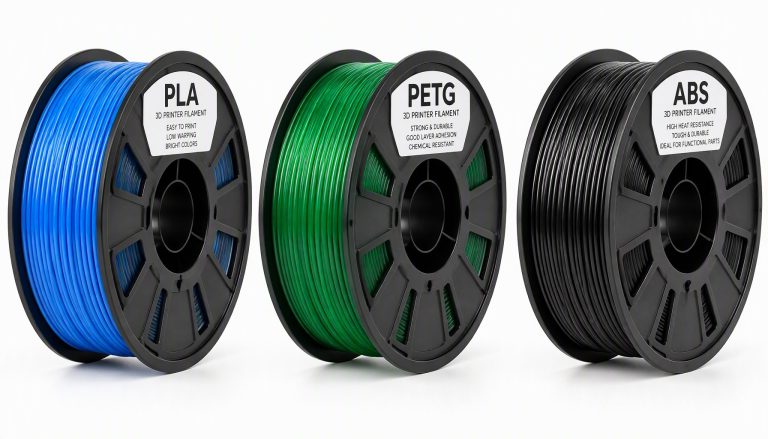
New to the materials themselves? Our filament guide covers PLA, PETG, ABS and the rest.
- Is PLA food safe?
- Bambu Lab says its PLA Basic is not food grade. Its PLA Pure passed an EU migration test under set conditions. No maker we read clears all PLA.
- Is PETG food safe?
- Of the makers we read, only Prusa Research talks about PETG, and its two pages differ in tone. Details below.
- What regulators judge
- Each substance that can move into food. The FDA ties an authorization to one company and one use. The EU keeps a list of allowed substances with migration limits.
- The print itself
- Every maker we read says layer lines trap food and germs, and that the nozzle matters.
- Our position
- No verdict. Read the maker’s own statement, follow its limits, or buy a product made for food.
From the FDA, the European Commission, Bambu Lab, Prusa Research and Polymaker, read November 12, 2026.
What food safe filament means to the FDA and the EU
The FDA in the United States
The FDA doesn’t certify spools. It rules on substances. A food contact material is judged by each substance in it that is “reasonably expected to migrate” into food. Each one needs a legal route. The FDA lists a regulation, GRAS status, a prior sanction, a Threshold of Regulation exemption, or a food contact notification.
Makers mention notifications most. The FDA says they “are specific to the company submitting the notification and to the specified intended use of the substance.” So a notification doesn’t cover the same substance made by another company, which means a claim printed on one brand’s spool doesn’t carry over to another brand, or to a new use.
The FDA’s bar is “reasonable certainty of no harm”. It also says it “can never be absolutely certain of the absence of any risk” from any substance. Its page files polymers under 21 CFR 177. This page doesn’t quote the regulation text itself.
Ask the maker in writing. The FDA says a buyer may ask the manufacturer for a letter of guaranty that a product is fine for the food use they have in mind. For filament, ask about your exact colour and your exact use.
The European Union
Regulation (EC) No 1935/2004 sets the ground rules for every food contact material in the EU. The European Commission says materials must not release their parts into food “at levels harmful to human health”. They also must not change the food’s taste, smell or makeup in an unacceptable way.
Plastics have their own rule, Commission Regulation (EU) No 10/2011. It keeps a Union List of substances allowed in plastic food contact materials. EFSA sets specific migration limits for listed substances from toxicity data. All substances together may not pass 60 mg per kg of food, or 10 mg per square decimetre of contact surface.
Labs test with food simulants under set times and temperatures. The Commission names 3% acetic acid as the stand in for acidic foods. The rule changes often, and the Commission’s page lists an amendment as recent as October 28, 2026.
What the makers say, in their own words
These are the makers’ statements about their own products. None of them is Planet 3DP’s opinion, and each was read on November 12, 2026.
| Maker and page | What it says | Where |
|---|---|---|
| Bambu Lab, PLA Basic | Says the filament isn’t food grade, so “please avoid using finished prints for food storage or contact”. | US store product page |
| Bambu Lab, TPU | “Do not use printed parts to hold or come into contact with food.” | Wiki, TPU Printing Guide |
| Bambu Lab, PLA Pure | Passed testing against EU 10/2011 at raw material and printed sample level. Still gives “no express or implied warranties regarding the safety, suitability, or regulatory compliance” for prints a user makes. | US store page and wiki guide |
| Prusa Research, Knowledge Base | “Waterbottle, no. Cookiecutter, maybe.” Its closing line says it does not recommend 3D prints as food containers. | Help article, undated |
| Prusa Research, blog | PLA, PETG or PP “should be safe even without any certification”. The same post says no print is food safe without a surface coating. | Blog post, December 4, 2020 |
| Polymaker | A compliant filament “does not automatically make the finished FDM print food safe”. | Wiki, Food Safety |
Bambu PLA Pure: what its test covers
Bambu Lab’s PLA Pure is the only filament in this set with a published food contact test. Bambu says each of its five ingredients passed EU food contact testing.
Its wiki gives the details. Printed samples sat in simulants for water, oil and acid at 70°C for 2 hours. Bambu says migration stayed below the 10/2011 limits “under the corresponding test conditions”. Then it lists food uses it doesn’t recommend for PLA Pure prints.
- Food contact above 60°C or below 0°C.
- Acidic, alkaline, organic solvent or corrosive liquids.
- Soaking in liquid foods for a long time, or long stays in very humid food settings.
- Long contact with very wet, very oily or hard to clean foods.
The store page adds: “Due to layer lines, printed parts are not suitable for holding liquid foods.” It says the certification “applies to the filament itself”. And the wiki says Bambu’s responsibility “is limited to the compliance and quality of the filament material as supplied”.
In short, by Bambu’s own account the test covers the plastic, not your print. If you want the filament anyway, it’s on Bambu Lab’s US store. The button is a store link, not a safety promise, so read Bambu’s conditions first.
Prices for other filaments are on our filament deals page.
Why a print isn’t the same as the plastic
Four risks come up again and again. Here’s who says what, in short, before the detail.
| Risk | Prusa | Polymaker | Bambu Lab |
|---|---|---|---|
| Layer lines | “a seedbed for bacteria” | Grooves trap residue and are hard to clean | Tiny pores can trap stains and microorganisms |
| Brass nozzle | It wears, and the worn metal ends up in the print | “raise extra concern” | Use a brand new nozzle that isn’t brass |
| Pigments and additives | May not be as neutral as the pure plastic | Colorants can fail even when the base polymer complies | Lists PLA Pure’s five ingredients |
| Heat and washing | Its 2020 blog says even coated prints don’t suit hot food, microwaves or dishwashers | Dishwashers and hot water can deform or degrade some prints | PLA Pure food contact: not above 60°C |
Layer lines
Prusa calls the grooves between layers “a seedbed for bacteria” that are “almost impossible to clean properly”. Polymaker says they “trap residue and make cleaning difficult”. Even Bambu’s guide for PLA Pure says tiny pores between layers “may trap stains and harbor microorganisms”.
The nozzle
A brass nozzle wears down. Prusa asks where the worn metal goes, and answers “Into your print.” Its view is that “a soft brass nozzle just won’t do”. Polymaker says brass nozzles “raise extra concern”. Bambu asks for a brand new nozzle that isn’t brass, kept only for PLA Pure. None of them says a steel nozzle makes a print safe.
Pigments and additives
Prusa says colour pigments and “unknown additives” may not be as neutral as the pure plastic. Polymaker says the base polymer can comply while “colorants, modifiers, or processing aids” are not. That’s why the maker’s statement has to cover your colour, not just the plastic type.
Heat and washing
Bambu’s material table says PLA isn’t recommended “for environments at about 50 ℃ or higher”, as it may soften and deform. For PLA Pure food contact, Bambu draws the line at 60°C. Polymaker warns that some prints “deform, leach, or degrade after dishwasher cycles, hot water, or repeated exposure to heat and detergents”. Prusa’s 2020 blog says even resin coated prints aren’t right for “hot soups, microwave ovens, or dishwashing machines”.
Is PETG food safe? And TPU, ABS and resin?
PETG. Prusa’s Knowledge Base says PETG, “and sometimes PLA”, is “hailed in the 3D printing community” as practically food safe. It notes that soda bottles are made of PET, a close relative. Its conclusion is still that it doesn’t recommend prints as food containers. Prusa’s 2020 blog is warmer, but it also says a print needs a coating. No other maker we read made a PETG claim, so this page doesn’t stretch Prusa’s words to other brands.
TPU. Bambu Lab’s TPU guide says not to use its TPU prints to hold or touch food.
ABS and ASA. Prusa’s blog calls most ABS or ASA filaments “rather unsafe” for direct food contact.
Resin. Asked whether resin prints get around layer lines, Prusa answers “Again, no.” It points to uncured resin and other contaminants.
For strength and heat differences between these plastics, see PLA vs PETG vs ABS.
If you still want to print for the kitchen
The makers line up on a handful of points. These are their steps, not ours.
- Keep contact short. Polymaker names cookie cutters, cake decorations and display pieces as the most reasonable uses. Prusa says a cookie cutter is a maybe, and something to throw away after some use.
- Get the maker’s statement. Ask for a food contact statement that covers your colour and your use. In the US, the FDA says you can ask for a letter of guaranty.
- Use a clean nozzle that isn’t brass. Bambu asks for a brand new one. Prusa names stainless steel or titanium.
- Design for cleaning. Bambu suggests rounded inside corners and no blind holes. Print food surfaces as sides or tops, never on the bed or on supports.
- Think about a coating. Polymaker says a coating only helps if it’s certified for food contact, and Prusa recommends a certified epoxy. Bambu names a resin certified under EU 10/2011 or FDA 21 CFR, such as a food grade clear epoxy.
- Or print a mold. Polymaker suggests treating the print as a prototype or mold, not the final food surface.
One nozzle, one job. Bambu suggests keeping that new nozzle only for PLA Pure. It also says not to share the print path with ABS, ASA, PC or fibre filled filaments when a part will touch food.
When to just buy one made for food
Polymaker says food contact printing gets “much harder to justify” for repeated use items like cups, utensils, storage containers or pet bowls. Prusa’s answer on a water bottle is no. Bambu says PLA Pure prints aren’t suitable for holding liquid foods.
So for a cup, a bowl, a drink bottle or anything bound for the dishwasher, the makers point the same way, and a product sold for food use comes with paperwork for exactly that job.
Health questions belong with the regulators. The FDA’s and the European Commission’s food contact pages are in the sources below.
Food safe filament questions
Is PLA food safe?
Not as a blanket rule. Bambu Lab says its PLA Basic is not food grade. Its PLA Pure passed EU 10/2011 migration tests on printed samples under set conditions, and Bambu still gives no warranty for prints you make.
Is PETG food safe?
Only Prusa Research addressed it among the makers we read. Its Knowledge Base says PETG is hailed as practically food safe but still doesn’t recommend prints as food containers. Its 2020 blog says PETG should be safe without certification, and that a print needs a coating.
Are 3D printed cookie cutters OK to use?
Polymaker lists cookie cutters among the most reasonable uses because contact is short. Prusa calls them a maybe and says to throw them away after some use, because layer lines collect food.
Is there FDA approved filament?
The FDA doesn’t approve filament as such. It authorizes food contact substances, and a food contact notification covers only the company that filed it and the use it names.
Does food safe filament make a food safe print?
Not by itself, according to the makers. Polymaker says a compliant filament does not automatically make the finished print food safe. Bambu says its certification applies to the filament itself.
Is TPU food safe?
Bambu Lab says its TPU is not food contact grade and that printed parts shouldn’t hold or touch food.
Watch Planet 3DP on YouTubeNew printers, filament news and slicer updates every week.
Subscribe- FDA: Understanding How the FDA Regulates Substances that Come into Contact with Food (content current as of May 8, 2025) (checked November 12, 2026)
- FDA: Determining the Regulatory Status of Components of a Food Contact Material (content current as of February 21, 2018) (checked November 12, 2026)
- European Commission: Food contact materials, legislation (checked November 12, 2026)
- Bambu Lab US store: PLA Basic product page (checked November 12, 2026)
- Bambu Lab US store: PLA Pure product page (checked November 12, 2026)
- Bambu Lab Wiki: PLA Pure Advanced Printing Guide (checked November 12, 2026)
- Bambu Lab Wiki: TPU Printing Guide (checked November 12, 2026)
- Bambu Lab Wiki: Filament guide material table (checked November 12, 2026)
- Prusa Knowledge Base: Food safe FDM printing (checked November 12, 2026)
- Prusa blog: How to make food grade 3D printed models (December 4, 2020) (checked November 12, 2026)
- Polymaker Wiki: Food Safety (checked November 12, 2026)

Host of Planet 3DP. He reports what makers and regulators publish and links every source. Planet 3DP on YouTube.
Last checked November 12, 2026.