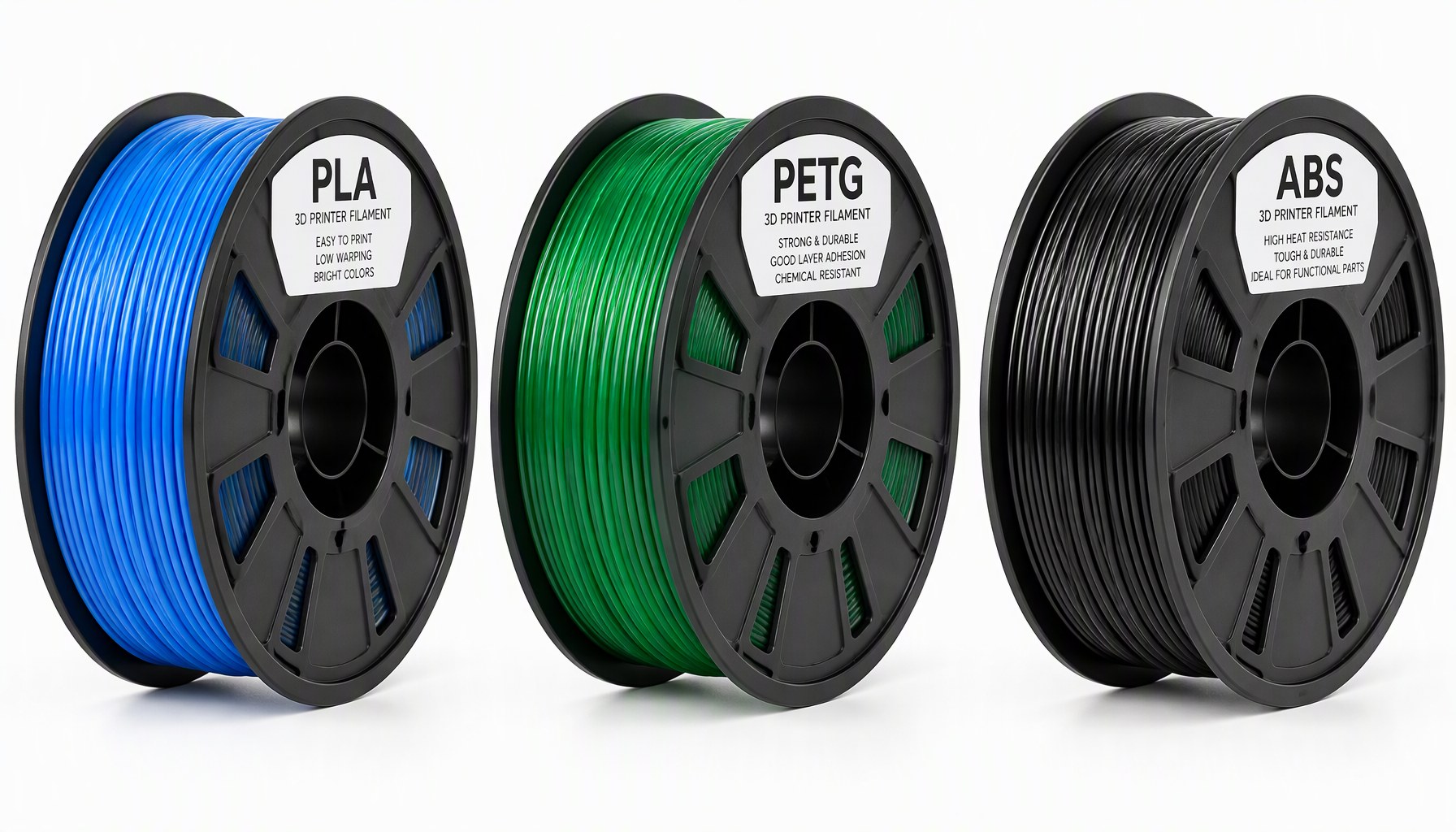

PLA, PETG or ABS? Most of the time the answer is PLA, and the other two are for jobs PLA can’t do. What follows is the printer maker’s own published table rather than the usual ranking, and on two counts the table disagrees with the ranking.
- Our pick for most prints
- PLA. Easiest to print, and stronger in tension than you’d think
- Pick PETG if
- The part lives outside, holds water, or gets knocked about
- Pick ABS if
- The part gets hot, and you own an enclosed printer
- Don't pick ABS if
- Your printer is open frame. Bambu says it isn’t recommended
- Numbers from
- Bambu Lab’s own material table, checked October 14, 2026
The short answer
PLA prints at the lowest temperature of the three, warps the least, and needs no enclosure. That’s why it’s the default. It gives up one thing, and it’s the thing people forget: it goes soft in heat. A PLA part on a car dashboard is a bad idea.
PETG runs hotter and sticks to itself better, so it takes a knock without snapping. It strings. You’ll clean up more wisps than you do with PLA.
ABS is the awkward one. It needs a hot bed, a hot chamber and an enclosure, and Bambu lists it as not recommended on an open frame printer at all. If you have an open printer, that decision is already made for you.
The numbers the maker publishes
These are Bambu’s own figures. The nozzle range carries a 10 C tolerance either way, which is the maker’s own wording, not a hedge.
| PLA | PETG | ABS | |
|---|---|---|---|
| Nozzle | 190 to 240 C | 240 to 270 C | 240 to 280 C |
| Bed | 35 to 65 C | 60 to 80 C | 90 to 100 C |
| Enclosure | Not needed | Not needed | Required |
| Hardened nozzle | Not required | Not required | Not required |
| Drying | 55 C for 8 hours | 70 C for 8 hours | 80 C for 8 hours |
| Heat deflection | 2 of 5 | 3 of 5 | 3 of 5 |
| Impact resistance | 2 of 5 | 3 of 5 | 3 of 5 |
| Tensile strength | 3 of 5 | 2 of 5 | 3 of 5 |
Two places the usual ranking is wrong
The familiar line is that PLA is weak, PETG is in the middle and ABS is strong. Bambu’s own table says something different in two places, and both are worth knowing before you buy a spool.
PLA pulls harder than PETG
On tensile strength, which is how hard you can pull something before it tears, Bambu rates PLA at 3 and PETG at 2. PLA is the stiffer, more brittle plastic, and stiff plastics tend to score well on a pull test and badly on a hammer test.
So if your part is being stretched or loaded in a straight line, PLA is not the weak option. If it’s being dropped or bent, it is.
PETG matches ABS on heat and impact
On heat deflection and on impact resistance, Bambu rates PETG and ABS the same: 3 and 3. ABS keeps one real advantage on paper, its tensile rating of 3 against PETG’s 2, and it wants a 90 to 100 C bed and an enclosure to get there.
Read that together and PETG starts to look like the sensible middle. You get ABS heat behaviour and ABS toughness on a printer that needs no enclosure.
The rule this leaves you with: reach for ABS when you need its tensile rating in a hot place, not because it has a reputation. For most hot or outdoor parts, PETG does the job on a printer you already own.
Can your printer even run it?
This is the question that settles it for most people, and it gets skipped. Bambu groups filaments by what the machine has to provide.
Its wording for the ABS group is that these materials require higher heatbed and chamber temperatures to suppress warping and layer separation. For the PLA group, it says they’re not prone to warping and have no mandatory temperature requirements.
| Open frame printer | Enclosed printer | AMS lite | |
|---|---|---|---|
| PLA | Fine | Fine | Fine |
| PETG | Fine | Fine | Fine |
| ABS | Not recommended | Recommended | Not recommended |
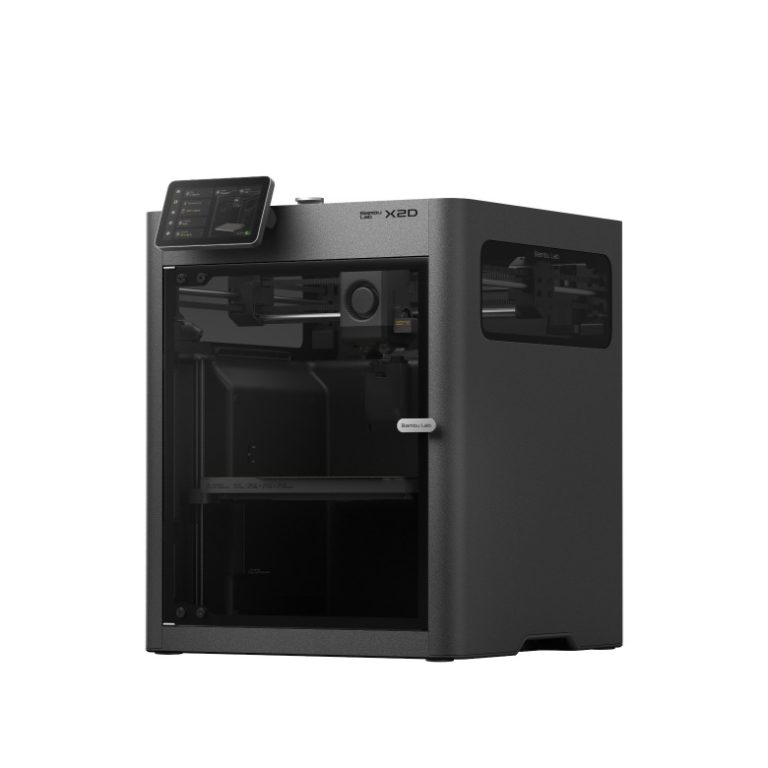
If you print on an A1 or another open machine, PLA and PETG are your two materials and that’s the whole decision. An enclosed printer like the P2S opens ABS and the rest of the engineering set.
New to this?The free beginner pack has a shopping list, a 30 day plan and a one page filament cheat sheet.
Get the free PDFDrying, and the one that insists on it
All three soak up moisture from the air. Wet filament pops, strings and prints weak. Bambu marks drying as recommended for PLA, PETG and ABS, and it marks one variant differently.
PETG HF, the high flow version, is listed as required rather than recommended, and it also wants desiccant kept with it while it prints. If you’ve been treating PETG HF like ordinary PETG, that’s worth changing today.
| Material | Drying | Oven condition |
|---|---|---|
| PLA | Recommended | 55 C for 8 hours |
| PETG | Recommended | 70 C for 8 hours |
| PETG HF | Required, plus desiccant in use | 65 C for 8 hours |
| ABS | Recommended | 80 C for 8 hours |
Wet filament is behind a lot of print faults people blame on the printer. There is more on that in our guide to common 3D printing problems.
Printing engineering filament?Our free pairing guide lists every engineering filament with the support material to run against it and the temperatures to use.
Get the free guideWhich one should you use?
Match the job rather than the reputation.
| The job | Use | Why |
|---|---|---|
| Models, toys, props, prototypes | PLA | Easiest to print and the best detail |
| A bracket that gets pulled or bolted | PLA or ABS | Both rate 3 of 5 on tensile. PLA if it stays cool |
| Anything left in a car or in the sun | PETG or ABS | PLA softens. Both of the others rate 3 of 5 on heat |
| Outdoor parts | PETG | Takes the heat and the knocks without needing an enclosure |
| Water tight or splash prone parts | PETG | Layers bond well and it shrugs off moisture |
| A part that gets dropped | PETG or ABS | Both rate 3 of 5 on impact, PLA rates 2 |
| A hot part that also gets pulled hard | ABS | The one place its tensile rating earns the enclosure |
One material this page leaves out on purpose is ASA. It’s close to ABS and holds up better outdoors, and it needs the same enclosure. The filament pillar covers it.
Common questions
Is PETG stronger than PLA?
It depends which kind of strong. Bambu rates PETG higher than PLA on impact resistance, 3 of 5 against 2 of 5, so it takes a knock better. It rates PLA higher on tensile strength, 3 of 5 against 2 of 5, so PLA resists a straight pull better. PETG also handles heat better.
Can I print ABS on an open frame printer?
Bambu lists ABS as not recommended on an open frame printer and recommended on an enclosed one. Its reason is that ABS needs higher bed and chamber temperatures to stop warping and layer separation. It also lists ABS as not recommended in the AMS lite.
What temperature do you print PLA, PETG and ABS at?
Bambu publishes a nozzle range of 190 to 240 C for PLA, 240 to 270 C for PETG and 240 to 280 C for ABS, each with a 10 C tolerance. Beds are 35 to 65 C for PLA, 60 to 80 C for PETG and 90 to 100 C for ABS.
Do I need to dry PETG before printing?
Bambu marks drying as recommended for ordinary PETG at 70 C for 8 hours. For PETG HF, the high flow version, it marks drying as required at 65 C for 8 hours and says to keep desiccant with the spool while it prints.
Which filament should a beginner start with?
PLA. It prints at the lowest temperature, warps the least and needs no enclosure, and Bambu lists no mandatory temperature requirements for it. Learn the printer on PLA, then add PETG when you need heat or toughness.
Does ABS need a hardened steel nozzle?
Not for plain ABS. Bambu lists a hardened steel nozzle as not required for PLA, PETG and ABS. The glass filled and carbon filled grades are a different matter, and Bambu does list a hardened nozzle as required for those.
Going further
This page answers the three way choice. For everything else that comes on a spool, including nylon, polycarbonate, TPU and the carbon filled grades, see our guide to 3D printer filament types.
Watch Planet 3DP on YouTubeNew printers, slicer updates and hands on tests every week.
Subscribe
Host of Planet 3DP. I have been 3D printing for over four years, with tens of thousands of print hours on Bambu Lab, Anycubic, Creality, Elegoo and Snapmaker machines. The numbers on this page are the maker’s published figures, not my own measurements. Planet 3DP on YouTube.
Last checked October 14, 2026.