
How Nick runs the H2S
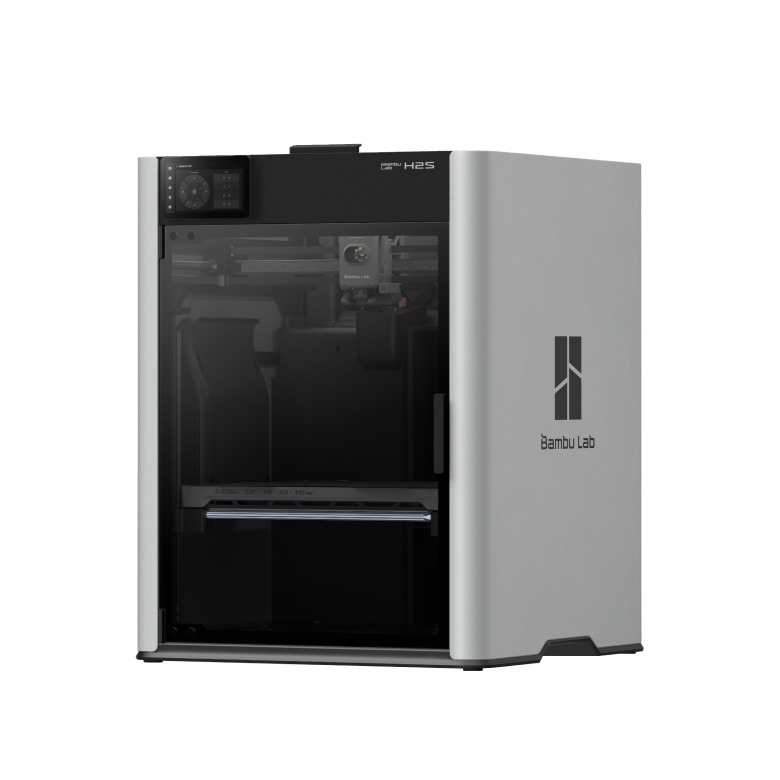
Planet 3DP’s Nick Nicholls has run an H2S in his office since autumn 2025, and it’s the machine he measures his H2C against (he had owned it about a month in this video). A Borderlands ripper mask the H2C printed in 2 days 5 hours was estimated at 4 days 1 hour on the H2S, and across three of his multicolour test prints the H2C saved 1,584 g of filament compared with running them here (watch at 5:07). That’s the trade the H2S makes. It has one nozzle, so every colour change is a purge.
Living with it
Bambu Lab lists the H2S at 30 kg, and Nick won’t carry it outside to blow it out the way he does with smaller printers (watch at 1:35). He follows Bambu’s simplified schedule, with the X axis linear guideway every month and everything else every three months (watch at 0:51). Expect a lot of filament dust inside, which he wipes out with IPA on a microfiber cloth. If you print more than 500 hours a month, or use the laser module, he would replace the carbon filter sooner (watch at 8:25). In another video he calls the H2S pretty quiet for an office printer (watch at 3:45).
His must print mod is the AMS flipper. The stock H2S already has close to an inch of clearance above the PTFE tube, so unlike the P2S it doesn’t need a riser. The flipper secures the AMS and lets you tilt it back to reach the top glass without disconnecting it (watch at 1:10). Keep the screws from the box, because the mod needs them.
Who it suits
In his H2C review Nick says the H2S still makes sense if you mainly print single colour with occasional multicolour work, or need the extra build volume for large functional parts (watch at 12:06). Bambu Lab gives it a 340 by 320 by 340 mm build volume, a 350°C hardened steel nozzle, a 65°C actively heated chamber and a 1,000 mm/s top toolhead speed, matching the table above, and lists ABS, ASA, PC, PA and fibre filled filament among its supported materials. If multicolour is a regular part of your printing, the H2C’s purge savings are the reason to pay more.