
Creality has opened US preorders for the K3 at 849 dollars, with an estimated ship date of 2 November. It is a four nozzle multicolour machine, and the pitch is that swapping whole nozzles instead of flushing one clears out the purge waste that multicolour printing normally throws away. Every performance figure below is Creality’s own, because the machine has not shipped and nobody has tested one independently.
- What it is
- The K3, Creality’s four nozzle multicolour flagship.
- Price
- 849 dollars on Creality’s own US store, checked October 16, 2026.
- Versions
- One. No bundle, and no struck through compare at figure.
- Availability
- Preorder, with an estimated ship date of 2 November.
- Build volume
- 260 by 260 by 260 mm.
- The idea
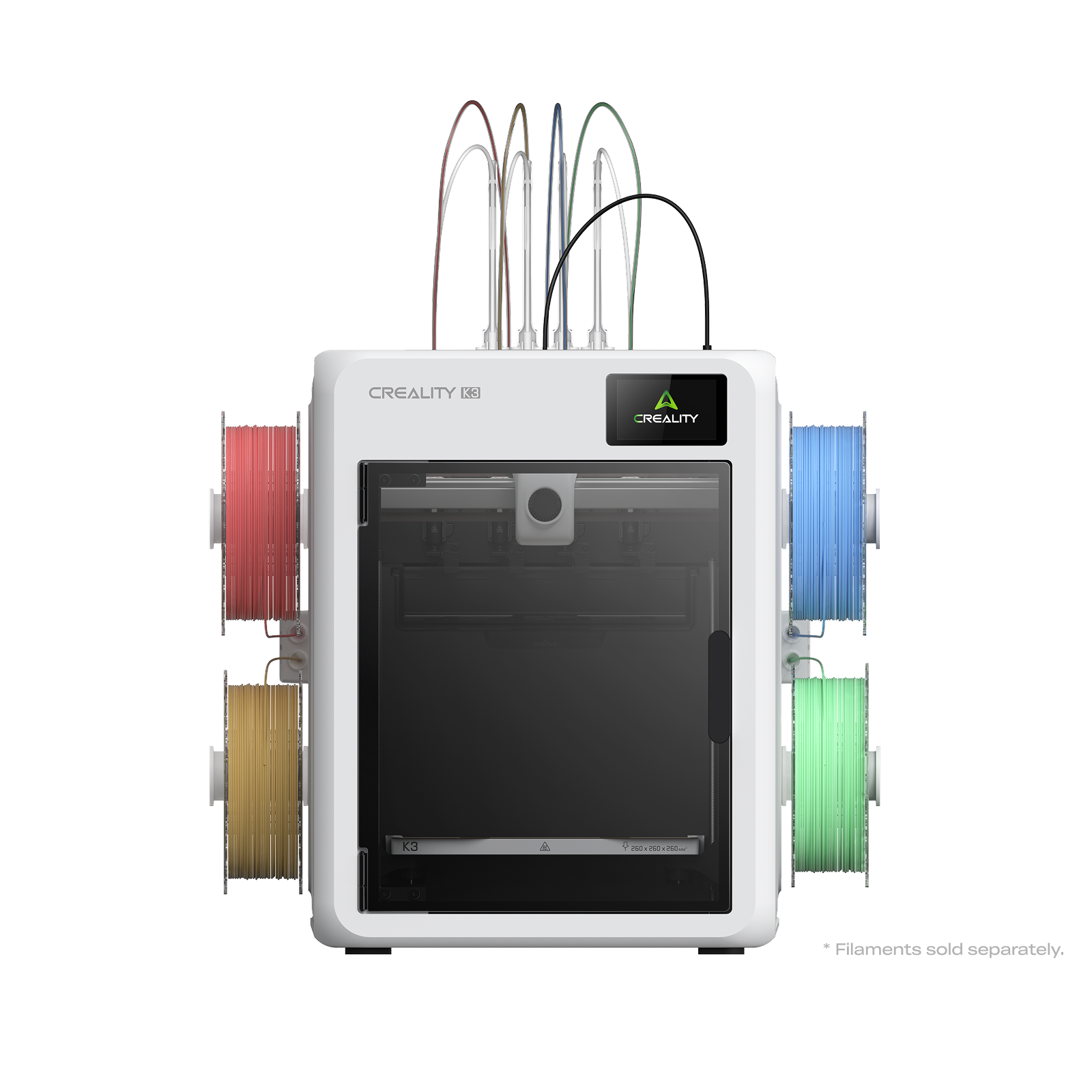
- Four nozzles, each with its own filament channel, swapped in about five seconds instead of purging one nozzle between colours.
- Tested by us
- No. Not seen, not run, not filmed.
Price and ship date read off Creality’s own store on October 16, 2026. Specs from Creality’s own product page the same day.
What Creality is actually selling
Multicolour printing on one nozzle costs filament. Every colour change means pushing the old material out before the new one goes in, and on a busy model that happens hundreds of times. It is the single biggest running cost in colour printing and it’s why the expensive machines avoid it.
The K3 attacks it the way toolchangers do. Four nozzles sit in the machine, each fed by its own channel, and the printer swaps the whole nozzle assembly rather than flushing one. Creality calls the mechanism KliTek and puts the swap at five seconds. Nothing is purged to make the change.
There is a second trick. Instead of adding spools for more colours, the K3 layers four CMYK filaments at controlled thicknesses and lets light pass through the material, so colours blend physically. Four spools, in principle a far wider range than four colours.
Nozzles come in 0.2, 0.4, 0.6 and 0.8 mm and can be mixed inside one print, which Creality notes needs configuring. The nozzle assemblies swap by USB C.
The specification, as Creality states it
| Specification | Figure |
|---|---|
| Printing technology | Fused filament fabrication |
| Build volume | 260 by 260 by 260 mm |
| Printing speed | 500 mm per second |
| Nozzles | Four, in 0.2, 0.4, 0.6 and 0.8 mm, mixable in one print |
| Nozzle change | About five seconds |
| Repeatability | Under 25 micrometres |
| Sensors | 37 built in |
| Printer dimensions | 420 by 482 by 536 mm |
| Net weight | 22 kg |
| Screen | 3.97 inch touchscreen |
| Camera | 720p with lighting |
| Rated power | 480W at 100 to 127V, 950W at 200 to 240V, standby around 160W |
The numbers Creality is advertising, and who measured them
This is where a launch story earns its keep. The headline figures are impressive and they are all Creality’s own, several footnoted to Creality Lab, and most carry a condition in small print. Here they are with the conditions attached.
| The claim | Whose measurement | The condition in the small print |
|---|---|---|
| Up to 80 percent less print time | Creality | Applies to a setup of four colours or fewer |
| Up to 85 percent less filament used | Creality | Same four colour condition |
| 231 g against 2,645 g on one model | Creality Lab | A Wolf Bust with 1,182 nozzle changes, K3 with a prime tower against a single nozzle printer with prime and purges |
| Up to 30 percent more efficient | Creality | Only when mixing a 0.4 mm wall nozzle with a 0.8 mm infill nozzle, which needs configuring |
| Seven times the flow rate on TPU | Creality Lab | 15 cubic mm per second with TPU 95A, against a standard consumer printer. TPU needs accessories sold separately |
| 30 percent more rigid | Creality | Structural rigidity and torsional resistance |
None of that makes the figures wrong. A nozzle swap really does avoid a purge, and the 231 g against 2,645 g comparison is the clearest illustration of why anyone would want this. But a maker’s lab number is a claim until somebody outside the company reproduces it, and the condition lines matter: the filament saving is quoted for four colours or fewer, and the TPU flow rate needs parts that cost extra.
Worth knowing: Creality’s own FAQ post of 30 September put the nozzle change at 4.8 seconds while the current product page says five. It is a trivial difference, and it is a useful reminder that launch figures move around before a machine ships.
The price, and what else 849 dollars buys
849 dollars is one version with no bundle, and the store showed no compare at price, so there is no discount being implied. The estimated ship date on the product page is 2 November, with no year printed beside it.
For context, the machines already in our directory that attack the same waste problem sit just below it. The Bambu Lab X2D is 649 dollars for the bare machine and 899 as the AMS Combo, and it uses two nozzles rather than four. The Snapmaker U1 is 749 dollars and uses a toolchanger. Both of those prices were read off the makers’ own stores on 15 October 2026.
So the K3 lands in a crowded bracket, and it is asking for more than the X2D’s base price while promising a more thorough answer to the same problem. Whether four channels beat two in practice is exactly the kind of thing that needs measuring rather than reading.
One promotion is worth flagging carefully. Creality’s launch announcement says preorders come with four free rolls of Hyper PLA and free shipping until 30 November. That offer was not visible on the store page when we loaded it on October 16, 2026, and no promotion on that page carried an end date, so check it in your basket before counting on it.
Who should care
If you print multicolour models regularly, this is the interesting machine of the month. The waste on a single nozzle printer is real money, and four channels with no purge between them is the most direct attack on it at this price.
If you print mostly in one colour, none of this is for you. You would be paying for a mechanism you never trigger, and a cheaper machine will print the same part.
And if you are about to preorder, the honest position is that nothing here has been verified outside Creality. The specification is Creality’s, the lab figures are Creality’s, and the first independent numbers will arrive when machines ship in November. Preordering is buying the claim, which is a reasonable thing to do with your eyes open.
Watch Planet 3DP on YouTubePrinter launches, slicer updates and every price checked at the source.
Subscribe- Creality official store: K3 preorder page, 849 dollars, one version, estimated ship date 2 November (checked October 16, 2026)
- Creality: K3 product page, the specification table and every performance claim with its footnotes (checked October 16, 2026)
- Creality blog: K3 questions answered, 30 September 2026, the earlier 4.8 second nozzle change figure and the pre launch pricing guidance (checked October 16, 2026)

Host of Planet 3DP. I have been 3D printing for over four years and run a print farm of Bambu Lab machines. Nobody at Planet 3DP has tested a K3, and no figure on this page is ours. Planet 3DP on YouTube.
Last checked October 16, 2026.