

Some links on this page are affiliate links. If you buy through one, Planet 3DP earns a small commission at no extra cost to you. It never changes what we recommend. How this works.
The Bambu Lab H2C swaps whole hotends instead of purging filament through one, and on three of Nick’s own multicolor prints that saved 1,584 g of filament. His verdict: if multicolor is a regular part of your printing, it’s the real fix for purge waste. If you mostly print one colour, the H2S still makes more sense. It’s 2,199 dollars as the AMS Combo today and 1,899 in Bambu Lab’s Black Friday sale from October 27.
Nick reviewed the H2C when it launched in November 2025, then filmed its setup, a bed adhesion test and its full maintenance routine. This page puts what he measured, what bugged him and what it costs to run in one place.
- Nick's verdict
- Buy it if multicolor or expensive engineering filament is a regular part of your printing. Stick with the H2S for mostly single colour work or the largest build volume.
- Price
- 2,199 dollars for the AMS Combo on Bambu Lab’s US store. 1,899 in Bambu’s Black Friday sale, October 27 to December 1.
- What he measured
- 1,584 g of filament saved across three prints, and a two day print that the slicer put at four days on the H2S.
- Reliability
- Zero mispicks after over 5,000 hotend changes in his testing.
- The catches
- A prime tower is still there, the hotend swaps are noisy, the bed is a little smaller than the H2S, and the cutter blades are fiddly to service.
- Not for
- A first printer. Nick says get your feet wet first.
Verdict and measurements from Nick’s own H2C videos, linked at each moment below. Prices read off Bambu Lab’s US store and its Black Friday sale page on October 26, 2026.
- 0:48 How Vortek works
- 2:44 Reliability so far
- 4:52 Test one, the ripper mask
- 6:11 Test two, the hand painted witch
- 8:36 The filament math
- 9:08 Price against the H2D and H2S
- 9:43 Noise
- 11:03 The trade offs
- 12:10 Who should buy it
The video has no chapters of its own. These jump links go to the moments this page quotes.
How Vortek works, in plain terms
Bambu Lab’s earlier multicolor machines push each new filament through a hotend that still holds the last colour, then purge the old colour out. That purge is the pile of filament poop under the printer, and on a model with hundreds of colour changes it can outweigh the print.
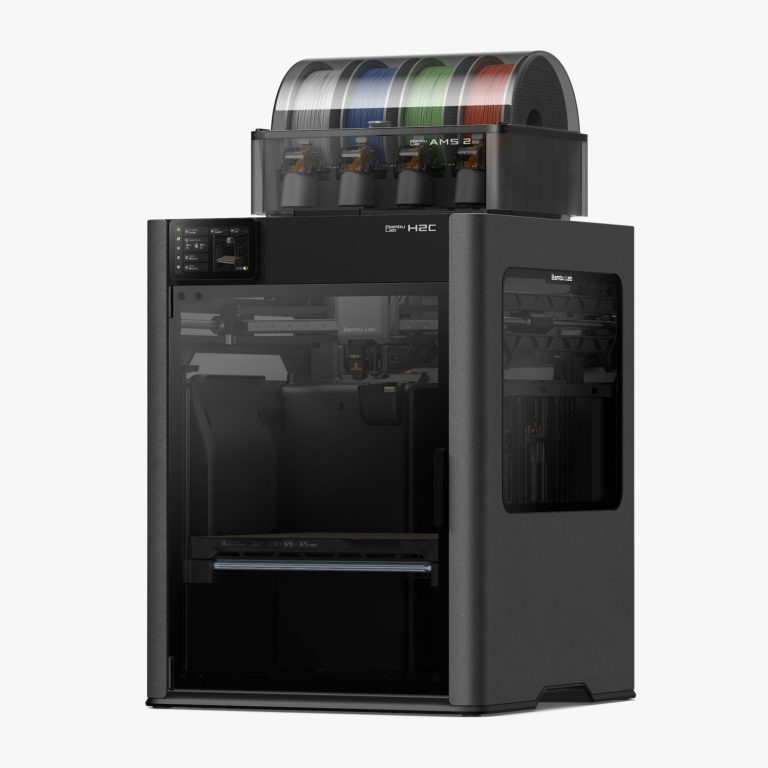
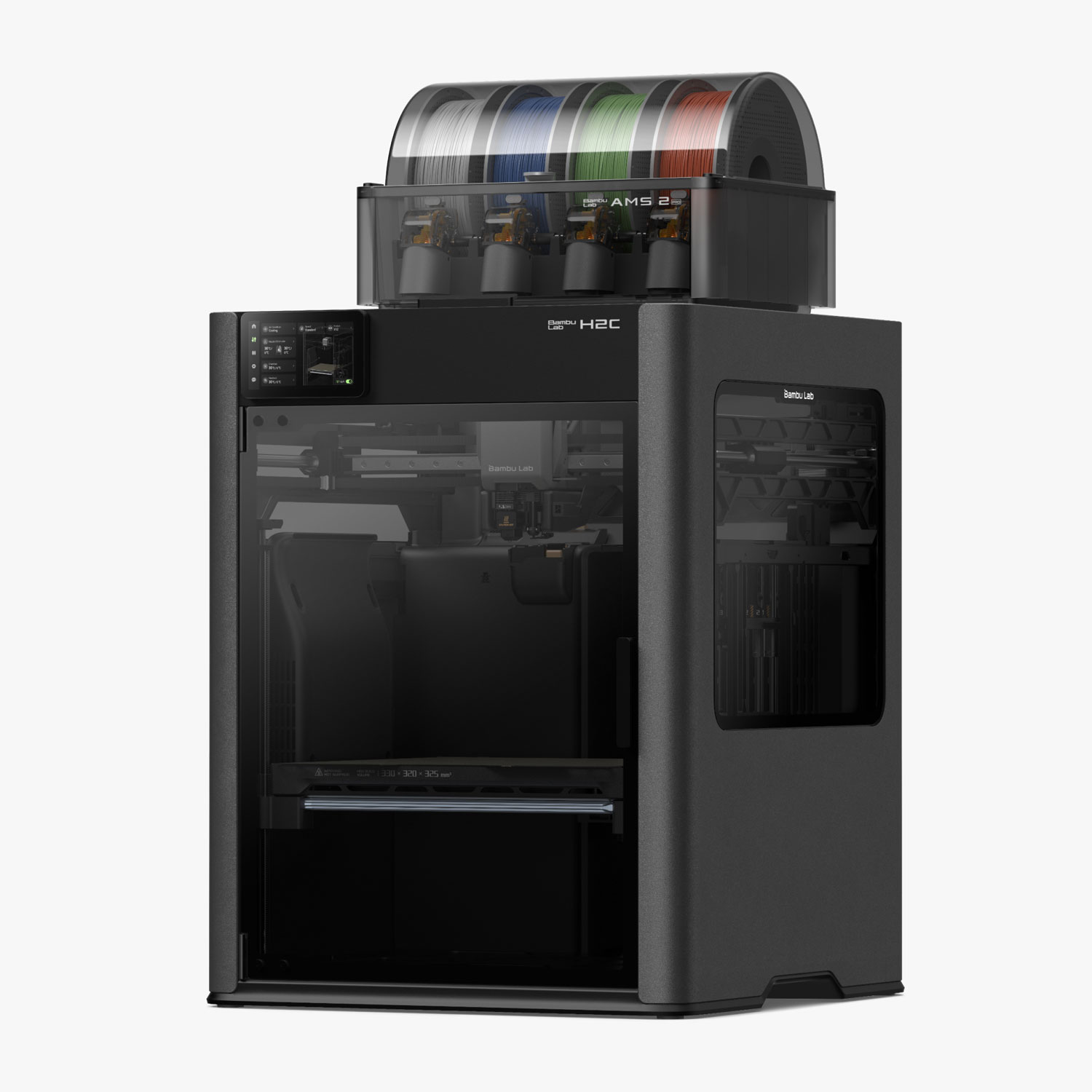
The H2C changes the hotend instead. It keeps up to six induction hotends in a rack on the right side, plus a fixed left nozzle, and swaps the whole hotend when the colour changes. Bambu Lab says induction heating brings a swapped hotend to temperature in 8 seconds, and the hotends connect without contacts, so there are no pins to wear. Nick’s comparison in the video is a good one: it’s like having several paint brushes instead of washing one over and over.
Bambu Studio decides which filament goes in which hotend. In Nick’s testing it read the model, looked at how often each colour appears, and assigned them itself.
| Spec | Bambu Lab H2C |
|---|---|
| Build volume | 330 x 320 x 325 mm, total for both nozzles |
| Hotends | Up to 6 swappable induction hotends on the right, plus the left nozzle |
| Hotend heat up | 8 seconds, with Bambu PLA Basic |
| Nozzle offset calibration | Automatic, to within 25 microns |
| Max nozzle and chamber | 350°C nozzle, 65°C actively heated chamber |
| Max speed | 1,000 mm/s toolhead, 20,000 mm/s² acceleration |
| Materials in one print | Up to 24 with several AMS units connected |
| Weight | 32.5 kg |
What Nick printed, and what it saved
The first print on his machine, right after a Benchy, was a Borderlands ripper mask. It took 2 days and 5 hours on the H2C. The slicer put the same model at 4 days and 1 hour on the H2S, almost double, because of purging and material swaps. It saved 853 g of filament, which he points out is almost a whole roll. That test starts at 4:52. He did see a few minor layer shifts near the top of the mask.
The second was a witch model his daughter painted in Bambu Studio, with about 1,400 to 1,500 colour changes. Nick’s review gives the higher figure, and the final slice in his setup video shows about 1,400. Against his H2S it saved 504 g. The reason it matters to him is personal. He’d been telling his daughter to keep her dragons to a couple of colours, because every extra colour meant more waste. The witch is at 6:11.
The third was a Grinch dog reindeer he mounted as a hood ornament on his off road vehicle. Small print, 227 g saved.
| Filament saved | Print time | |
|---|---|---|
| Ripper mask | 853 g | 2 days 5 hours, against 4 days 1 hour estimated on the H2S |
| Hand painted witch | 504 g | Not stated |
| Grinch dog reindeer | 227 g | Not stated |
| Total, three prints | 1,584 g | About one and a half rolls |
His rough money math in the video: at about 15 dollars a roll, those three prints saved about 22 dollars of filament. Ten ripper masks would save over 130 dollars, before counting the print time. The filament math is at 8:36.
What isn’t zero
The review calls the witch print zero poop waste, and the purge pile really is gone. Two things are left, and Nick shows both in his setup video.
First, a prime tower. When he sliced the witch, the prime tower was still 23% of the print, and he said it out loud: still can’t get rid of the prime tower. That slice came to 165 g of filament in total.
Second, each hotend primes once the first time a filament is loaded into it. He calls that getting the nozzle filled with colour rather than waste, and Bambu Lab’s own fine print says the same: the no purging claim doesn’t include the first purge of a new filament. That part is at 8:26.
So the honest summary is much less waste, not none. On a print with a thousand colour changes, that’s still the difference he measured above.
Living with it
Reliability. Zero mispicks after over 5,000 hotend changes, and no maintenance on the hotend changer itself during his testing. That’s at 2:44.
Noise. Louder than an A1, which he calls super quiet. The worst of it is the hotend swap: a brief hum from the induction heating and some clunking from the mechanism. It lasts seconds, not minutes, and he still takes phone calls with it running in his office. Noise is at 9:43.
Wobble. It prints like the H2S and moves around a lot while it does. That’s the direction Bambu Lab has taken with these machines and it doesn’t bother him.
Bed size. The hotend rack takes a strip of the bed. Bambu lists 330 x 320 x 325 mm for the H2C against 340 x 320 x 340 for the H2S. Nick expected a much smaller plate when he unboxed it and calls the trade very reasonable for most prints. Build plates don’t swap with the H2D, Bambu says, because the H2C bed is slightly smaller.
Bed adhesion. When a bed adhesion complaint went round in launch week, Nick made a short video testing it. Full bed sheets of PETG half a millimetre thick, on a generic profile he hadn’t calibrated, came off flat. The two day mask’s supports held all the way. His answer was no bed adhesion problems on his machine.
Weight. Bambu lists it at 32.5 kg, and Nick says it’s over 70 pounds. He won’t carry it outside to clean it, and he moved his onto a rolling cart, which he covers in his BIQU Panda Station review.
What the Combo includes, and what full swapping needs
The AMS Combo comes with one AMS 2 Pro and eight hotends, six for the swapping side and two for the left nozzle.
| Part | In the AMS Combo | Bambu’s add for full six hotend swapping |
|---|---|---|
| Right induction hotends, 0.4 mm | 4, hardened steel | 3 more |
| Right induction hotends, other sizes | One 0.2 mm and one 0.6 mm | None |
| Left standard hotends | 2, 0.4 mm hardened steel | One 0.2 mm and one 0.6 mm |
| AMS units | 1 AMS 2 Pro | Another AMS 2 Pro and an AMS HT |
The firmware doesn’t yet let one print mix nozzle sizes, so out of the box you have four matching 0.4 mm hotends to swap between, not six. Nick was already waiting on extra 0.4 mm hotends in his setup video.
Budget for that if you want everything the marketing shows. Bambu’s own note says the advertised Vortek advantages assume all six induction hotends of one size and the matching AMS units.
What it takes to keep running
In Nick’s words the H2C has a lot going on under the hood, and his maintenance video walks through all of it. The schedule is simple, because it runs on time, not print hours. The schedule is at 1:51.
| How often | What gets done |
|---|---|
| Every month | X axis linear guideway and rods, the left nozzle lifting rail, the induction hotend rack |
| Every 3 months | Everything else: Z rods and lead screws, carbon filter, exhaust grill, the AMS, fans and a full dust clean |
| When they wear | Cutter blades, nozzle boots, and the carbon filter sooner if you run a laser module or more than 500 hours a month |
One honest gripe from that video: the filament cutter blades. The H2C does a lot of cuts, so he checks both blades for chips, and getting them back in isn’t as easy as on a P or A series machine. He’d taken them out about five times and still hadn’t found a trick. That’s at 7:39.
Nick turned the whole routine into a free one page checklist with a tracking section. It’s on the H2C maintenance page, and if you also run an H2S there’s a separate H2S guide.
Keep it running like day one Nick’s printable H2C maintenance checklist, monthly and three month steps on one page.
Get the H2C checklistH2C, H2D or H2S: the price gap
At launch Nick read out 2,399 dollars for the H2C Combo, 1,999 for the H2D Combo and 1,499 for the H2S Combo, and said the 900 dollar gap over the H2S gets eaten up fast if you print multicolor regularly. That’s at 9:08. Prices have dropped since.
| AMS Combo | Bambu store today | Black Friday price | Build volume | Multicolor |
|---|---|---|---|---|
| H2C | 2,199 dollars | 1,899 dollars | 330 x 320 x 325 mm | Swaps whole hotends |
| H2D | 1,749 dollars | 1,599 dollars | 350 x 320 x 325 mm | Two nozzles |
| H2S | 1,399 dollars | 1,249 dollars | 340 x 320 x 340 mm | Purges at each change, Nick’s baseline |
So today the H2C costs 800 dollars more than the H2S Combo and 450 more than the H2D Combo. In the sale those gaps are 650 and 300. Our Bambu Lab Black Friday page tracks the rest of the range.
One dated fact if you’re timing a purchase. Bambu Lab’s home page dates a new tool changer, the H3C, for November 3 at 9:00 AM EST (read October 26, 2026). We don’t know its price, specs or what it means for the H2C, so this page doesn’t guess.
Who should buy the H2C
Buy it if multicolor printing is a regular thing for you, and especially if you’ve been simplifying models to keep the colour count down. Nick’s point is that it removes the mental math of 500 colour changes in the slicer.
Buy it if you print carbon fibre and other filament that costs around 80 dollars a roll. Dedicated hotends mean that filament isn’t purged into the bin or contaminated by the last colour.
Pick the H2S if you mostly print one colour with the odd multicolor job, or you need the biggest build volume for large functional parts. That’s Nick’s own line in the verdict above.
And don’t make it your first printer. His advice on the zero waste machines, the H2C and the Snapmaker U1, is to get your feet wet first, in his beginner printers video.
What about the Snapmaker U1?
The Snapmaker U1 attacks the same purge problem another way, with four separate toolheads instead of one toolhead that swaps hotends. Nick owns both, and his U1 review video covers its setup and first prints. It was 749 dollars on Snapmaker’s US store on October 26, 2026, and you can line the two up spec for spec in our compare tool.
Bambu Lab H2C questions
Is the Bambu Lab H2C worth it?
If multicolor or expensive engineering filament is a regular part of your printing, Nick’s answer is yes. On three of his prints it saved 1,584 g of filament. If you mostly print one colour, he says the H2S still makes more sense.
How much filament does the H2C save?
On Nick’s prints, 853 g on a ripper mask, 504 g on a hand painted witch and 227 g on a small Grinch dog, against the same models on a purging setup. A prime tower and a first prime per hotend remain, so it is much less waste rather than none.
How much is the Bambu Lab H2C?
2,199 dollars for the AMS Combo on Bambu Lab’s US store, checked October 26, 2026. In Bambu’s Black Friday sale, October 27 to December 1, it is 1,899 dollars. It launched at 2,399.
Does the H2C have bed adhesion problems?
Not on Nick’s machine. He printed full bed PETG sheets half a millimetre thick on an uncalibrated generic profile and full bed sets of mod parts with no warping, and the supports on a two day print held to the end.
Is the H2C loud?
Louder than an A1. The noise comes during hotend swaps, a short hum and some clunking that last seconds. Nick runs it in his office and still takes phone calls.
What is the difference between the H2C, H2D and H2S?
The H2C swaps whole hotends to cut purge waste. The H2D is a dual nozzle machine, and the H2S has the largest build volume at 340 x 320 x 340 mm. As AMS Combos on Bambu’s US store they were 2,199, 1,749 and 1,399 dollars on October 26, 2026.
- Planet 3DP video: Honest Bambu Lab H2C Review (November 2025). The tests, savings, launch prices, noise and the verdict at 12:10 and 12:52 (checked October 26, 2026)
- Planet 3DP video: No More Purge Waste, the H2C multicolor setup (November 2025). Prime tower and first prime (checked October 26, 2026)
- Planet 3DP video: Proving the H2C Doesn't Have Bed Adhesion Problems (November 2025) (checked October 26, 2026)
- Planet 3DP video: 3D Printer Maintenance That Makes Your Bambu H2C Last 10x Longer (February 2026) (checked October 26, 2026)
- Planet 3DP video: BIQU Panda Perch Review (April 2026), the H2C's weight (checked October 26, 2026)
- Planet 3DP video: I Ran All 3 Of The Best Beginner 3D Printers (August 2026) (checked October 26, 2026)
- Bambu Lab: H2C technical specifications (checked October 26, 2026)
- Bambu Lab US store: H2C price, Combo contents, Vortek FAQ and fine print (checked October 26, 2026)
- Bambu Lab US store: H2D price and build volume (checked October 26, 2026)
- Bambu Lab US store: H2S price and build volume (checked October 26, 2026)
- Bambu Lab US store: Black Friday sale page, dates and prices (checked October 26, 2026)
- Bambu Lab home page: the H3C date (checked October 26, 2026)
- Planet 3DP video: Snapmaker U1 Review, Unboxing, Setup and First Prints (May 2026) (checked October 26, 2026)
- Snapmaker US store: Snapmaker U1 price (checked October 26, 2026)

Host of Planet 3DP. I reviewed the H2C at launch in November 2025, measured its savings on my own prints and filmed its full maintenance routine. Planet 3DP on YouTube.
Last checked October 26, 2026.