

Some links on this page are affiliate links. If you buy through one, Planet 3DP earns a small commission at no extra cost to you. It never changes what we recommend. How this works.
For 3D printed car parts, ASA is the filament to start with. It has the highest heat rating of the three in Bambu Lab’s own datasheets, and it’s the one Bambu writes up for long outdoor exposure. ABS is its close cousin for parts in the shade. PETG prints on any printer, but it softens about 30°C sooner, so keep it out of the sun.
That’s the short version. The longer one depends on where the part lives in the car and which printer you own. ASA and ABS both want an enclosed printer. PETG doesn’t. So for a lot of people the real question is PETG or a new printer.
This guide puts Bambu’s lab numbers for all three side by side, says what those numbers can’t tell you, and draws a firm line on parts you shouldn’t print at all. For the basics of the three everyday plastics, see PLA vs PETG vs ABS. For every other material, our complete filament guide has the lot.
None of this has been heat tested in a car by Nick. Every car claim here is spec based and not tested by Nick.
ASA vs ABS (and PETG) for 3D printed car parts: the short answer
- Sun on the part (dash, rear shelf, outside)
- ASA. Highest heat deflection of the three, and Bambu pitches it for long outdoor exposure
- Cabin parts out of direct sun
- ABS works, and prints with the same settings as ASA
- Open frame printer like an A1
- PETG, for shaded parts only. Bambu marks ABS and ASA not recommended on open printers
- Never
- PLA. Bambu says it isn’t for anywhere at about 50°C or higher
- Don't print
- Anything that steers, stops, holds you in or carries fuel
From Bambu Lab’s ASA, ABS and PETG datasheets and its wiki material table, read November 18, 2026. Spec based. Not tested by Nick in a car.
The heat numbers, side by side
Heat deflection is the temperature at which a standard test bar bends a set amount under a set load. Bambu tests at two loads. The lighter one, 0.45 MPa, is closer to a part that just has to hold its own shape. The heavier one, 1.8 MPa, is a part under real stress.
On both, ASA comes out on top, ABS sits in the middle and PETG trails. At the lighter load the gap between ASA and PETG is 31°C.
| Bambu datasheet figure | ASA | ABS | PETG Basic | PETG HF |
|---|---|---|---|---|
| Heat deflection, 0.45 MPa | 100°C | 87°C | 69°C | 69°C |
| Heat deflection, 1.8 MPa | 92°C | 84°C | 65°C | 62°C |
| Vicat softening | 106°C | 94°C | 78°C | 70°C |
| Glass transition | N/A on the sheet | N/A on the sheet | 68°C | 66°C |
| Tensile strength, along layers | 52 MPa | 41 MPa | 48 MPa | 34 MPa |
| Tensile strength, across layers | 35 MPa | 32 MPa | 39 MPa | 23 MPa |
| Impact strength, unnotched | 41.0 kJ/m² | 39.3 kJ/m² | 52.7 kJ/m² | 31.5 kJ/m² |
| Water absorption (25°C, 55% RH) | 0.45% | 0.65% | 0.32% | 0.40% |
| Oil and grease | Not resistant to some | Not resistant to some | Resistant to most | Resistant to most |
Heat isn’t the only line worth reading. PETG Basic posts the best impact figure and the best strength across layers of the four. Bambu also rates both PETGs resistant to most oils and greases, while ASA and ABS are not resistant to some. That matters for anything near a greasy hand or a cleaning product.
What a datasheet can’t tell you about a hot car
Here’s the catch. A heat deflection figure is a lab number, not a forecast for your dashboard.
| How Bambu made the number | How your part differs |
|---|---|
| Solid test bars, 100% infill | Most printed parts have walls and infill |
| Annealed and dried before testing (ASA and ABS at 80°C for 12 hours) | Most prints go straight off the plate |
| One load, for the length of the test | A car part sits in the heat for months |
| Printed on Bambu’s settings | Your printer, your slicer, your settings |
Bambu says as much. Its datasheets call the values “for design reference and comparison only” and add that users are responsible for the legality, safety and performance of what they print.
So use the numbers to rank the plastics, not to promise a part will survive. How hot a parked car gets depends on the sun, the colour of the cabin and where the part sits. This page has no measured figure for that, so it doesn’t print one.
Why Bambu’s star chart says they’re equal
Bambu’s wiki rates materials with stars. On heat, PETG, ABS and ASA all get three. PLA gets two. PC gets four and the nylon blends with carbon or glass fibre get five.
Three stars each looks like a tie. Bambu’s own datasheets say otherwise, by 31°C at the lighter load. The stars are a broad bucket, and all three land in it. For a part that sits in the sun, trust the datasheet ranking over the stars.
ASA vs ABS: what actually separates them
On a spool they’re close cousins. Bambu prints both at a 240 to 270°C nozzle, an 80 to 100°C bed and a 45 to 60°C chamber, by their datasheets. Bambu’s wiki gives a wider 240 to 280°C nozzle range. This guide uses the datasheet figure.
Three things split them.
- Heat. ASA’s heat deflection is 13°C higher at the lighter load and 8°C higher at the heavier one.
- Outdoor use. Bambu’s ASA sheet pitches it for outdoor models and for structural parts that face tough outdoor conditions for a long time. Its ABS sheet lists UV resistance too, but doesn’t pitch ABS for outdoor work. Neither sheet gives a UV test figure.
- Moisture. ABS soaks up more water at saturation, 0.65% against 0.45% for ASA.
If the part lives in the shade of a door pocket or under a seat, ABS will do. If the sun can reach it, ASA is the safer bet. Check both prices on the day, because sales move them around.
Nick said that at the start of his ASA round on the Bambu X2D. The video is a support peel test, not a heat test or a car test. ASA shows up twice in it: as a support interface, and as the part itself. More in his X2D engineering filament test write up.
- 0:00Which support peels cleanest?
- 0:12The setup (how the test works)
- 2:25Nylons: SUNLU EZ PA
- 2:45Nylons: PA12-CF
- 3:15Nylons: PA6-GF
- 3:45Nylons: PA6-CF (the twist)
- 5:38ABS/PC: ASA
- 6:42ABS/PC: ABS-GF
- 7:00ABS/PC: PC-ABS
- 7:26ABS/PC: PC (the tradeoff)
- 8:59Bonus round: TPU (+ AMS 2 Pro warning)
- 11:11The final cheat sheet (which support wins)
Free filament pairing guideEvery filament from Nick’s X2D test, the support to run with it and the temperatures, on one page.
Get the free guideWill PETG melt in a car?
Melt, no. Soften and sag, possibly. Bambu puts PETG Basic’s glass transition at 68°C and PETG HF’s at 66°C. Its heat deflection at the lighter load is 69°C for both. Those are the lowest numbers on this page, and well under ASA’s 100°C.
Other brands’ PETG will differ, so read the datasheet for the spool you buy.
Where PETG earns its place is the printer. Bambu marks it compatible with open frame printers, unlike ABS and ASA. Its wiki does add one note: an enclosed printer is recommended for PETG too, because cold room air can weaken the bond between layers.
Rule of thumb: PETG for parts in the shade of the cabin. Not for the top of the dash, the rear shelf or anything on the outside.
Your printer decides as much as the plastic
Bambu groups ABS and ASA with PC and nylon as materials that need higher bed and chamber temperatures to stop warping and layer splits. Its wiki recommends an enclosed printer for all of them and marks open frame machines not recommended.
| ASA | ABS | PETG | |
|---|---|---|---|
| Open frame (A series) | Not recommended | Not recommended | Compatible |
| Enclosed (H2 series, X2D, P2S, X1, P1S) | Recommended | Recommended | Compatible, enclosure recommended |
| Bed, datasheet | 80 to 100°C | 80 to 100°C | 65 to 75°C (Basic) |
| Chamber, datasheet | 45 to 60°C | 45 to 60°C | 35 to 50°C (Basic) |
| AMS | Compatible | Compatible (not recommended for AMS lite) | Compatible |
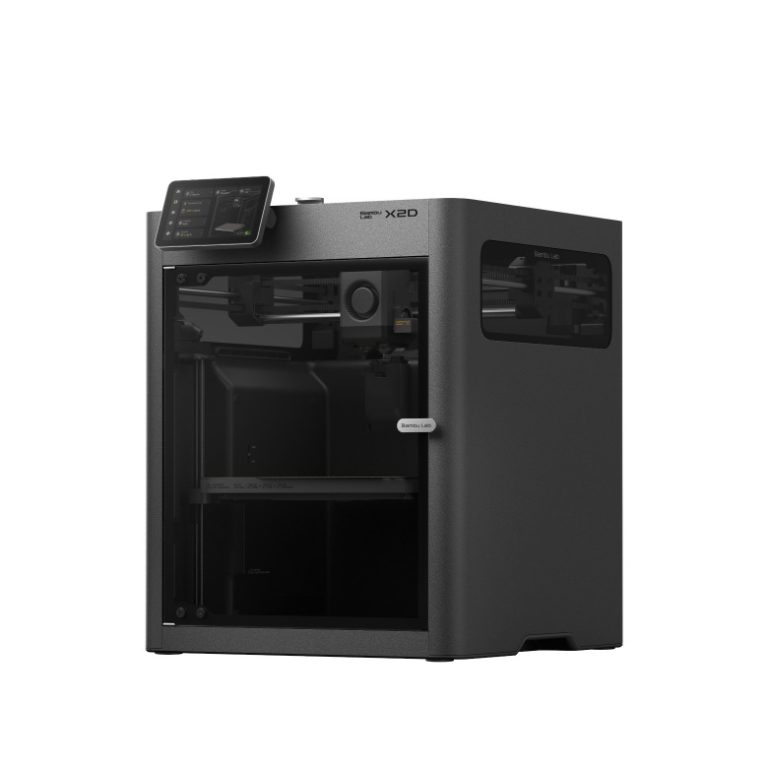
Own an open Bambu Lab A1? PETG is your car filament unless you add an enclosed machine. On the enclosed side, the P2S and P1S are both enclosed. Nick ran his ASA on the X2D. Our P2S vs P1S comparison covers the cheaper pair.
Which car parts to print, and which to leave alone
This part is editorial caution, not safety or legal advice. Nothing printed at home is approved for any vehicle by this guide, and Bambu’s own sheets leave safety and legality with the user.
| Where the part sits | Filament to start with | Examples |
|---|---|---|
| Cabin, out of direct sun | PETG or ABS | Door pocket organisers, under seat trays, cable clips |
| Cabin, in the sun | ASA | Phone and dash mounts, vent clips, parts on the rear shelf |
| Outside the car | ASA | Badge backs, small trim covers, caps |
| Near the engine | None of these three | Bambu’s stars rate PC and fibre filled nylon higher on heat |
Don’t print these
- Anything in the steering, brakes or suspension
- Seatbelt parts, or anything near where an airbag deploys
- Fuel system parts
- Anything structural, or anything whose failure could hurt someone
If a broken part would only cost you a reprint, it’s a fair job for a home printer. If it could cost more than that, buy the real part.
Dry it before you print it
Wet filament prints weak, rough parts. Bambu recommends drying all three before use, and its datasheets ask for storage below 20% humidity, sealed with desiccant.
Those are Bambu’s figures from its Filament Drying Guide. On the heatbed of an enclosed Bambu printer it gives 90 to 100°C for 12 hours for ASA and ABS, and 75 to 85°C for 12 hours for PETG. PETG in an oven wants 60 to 65°C for 8 hours.
The AMS 2 Pro tops out at 65°C, which Bambu says may not fully dry ASA or ABS. Use an AMS HT, an oven or a dryer. Compare them in our best filament dryers guide, and see the signs of a wet spool in our common printing problems guide.
Who should buy which
These picks are by job, from the makers’ own pages. None was tested by Nick on a car.
Bambu Lab ASA
Best for parts the sun can reach, on an enclosed printer. Not tested by Nick in a car.
- Highest heat deflection here: 100°C at 0.45 MPa, 92°C at 1.8 MPa
- Bambu pitches it for long outdoor exposure
- AMS compatible. Needs an enclosed printer
- Black was out of stock when checked
$29.99 list for 1 kg with spool (on sale for $17.99), list price checked November 18, 2026
Check price at Bambu LabBambu Lab ABS
Shaded cabin parts on an enclosed printer. Not tested by Nick in a car.
- 87°C heat deflection at 0.45 MPa
- Same print settings as ASA, by Bambu’s datasheets
- Absorbs more water than ASA, so keep it sealed
- $18.99 for 1 kg with spool at Bambu Lab’s US store, checked November 18, 2026
Bambu Lab PETG Basic
Open frame printers and parts in the shade. Not tested by Nick in a car.
- 69°C heat deflection at 0.45 MPa, the lowest here
- Best impact and across layer strength of the four in the table
- Resistant to most oils and greases, by Bambu’s sheet
- $16.99 for 1 kg with spool at Bambu Lab’s US store, checked November 18, 2026
SUNLU ASA
Another ASA, and one Nick links in his X2D test video. Not tested by Nick in a car.
- An ASA, so it needs an enclosed printer like any other
- No SUNLU datasheet was read for this guide, so no SUNLU figures are printed
- Check the current price on SUNLU’s store
On a budget? Our price tracker had SUNLU ABS at $10.69 and SUNLU PETG at $10.58 a kilo on SUNLU’s store when checked November 18, 2026, against list prices of $19.99 and $18.99. PETG HF is Bambu’s faster PETG with the same 69°C deflection as Basic. The filament deals page tracks the rest.
Car parts filament questions
What is the best filament for 3D printed car parts?
ASA for anything the sun can reach. Bambu’s datasheet gives it the highest heat deflection of the common plastics here, 100°C at 0.45 MPa, and pitches it for outdoor use. It needs an enclosed printer.
Is ASA better than ABS?
For car parts in the sun, yes. Bambu’s ASA deflects at 100°C against 87°C for its ABS, and absorbs less water. Indoors and in the shade, ABS does the job too.
Will PETG melt in a car?
Bambu puts PETG Basic’s glass transition at 68°C and its heat deflection at 69°C. It won’t melt at those temperatures, but it can soften and sag. Keep PETG parts out of direct sun.
Can I use PLA for car parts?
Bambu says PLA isn’t recommended anywhere at about 50°C or higher, because it may slowly soften and deform. Use ASA, ABS or PETG instead.
Can a Bambu Lab A1 print ASA?
Bambu marks ASA and ABS not recommended on open frame printers such as the A series. PETG is compatible with them.
What temperature do you print ASA at?
Bambu’s ASA datasheet gives a 240 to 270°C nozzle, an 80 to 100°C bed and a 45 to 60°C chamber. Dry it at 80°C for 8 hours first.
- Bambu Lab ASA Technical Data Sheet V2.0 (PDF) (checked November 18, 2026)
- Bambu Lab ABS Technical Data Sheet V2.0 (PDF) (checked November 18, 2026)
- Bambu Lab PETG Basic Technical Data Sheet V2.0 (PDF) (checked November 18, 2026)
- Bambu Lab PETG HF Technical Data Sheet V1.0 (PDF) (checked November 18, 2026)
- Bambu Lab wiki: filament guide material table (checked November 18, 2026)
- Bambu Lab wiki: Filament Drying Guide (checked November 18, 2026)
- Bambu Lab US store: ASA, price (checked November 18, 2026)
- Planet 3DP video: I Tested Every Engineering Filament on the Bambu X2D (July 2026), ASA at 5:21 (checked November 18, 2026)

Host of Planet 3DP. He printed ASA parts and ASA support interfaces on his Bambu X2D in his July 2026 engineering filament test. Planet 3DP on YouTube.
Last checked November 18, 2026.