

Some links on this page are affiliate links. If you buy through one, Planet 3DP earns a small commission at no extra cost to you. It never changes what we recommend. How this works.
Carbon fiber filament is a regular plastic with short, chopped carbon fibers mixed in. Is it worth it? It depends on the plastic underneath. In PLA and PETG it buys a matte look and a bit more stiffness, nothing dramatic. In nylon it makes stiff, heat resistant engineering parts. Either way you need a hardened steel nozzle, and Bambu Lab says brass and stainless steel wear out too fast.
This guide answers three questions in order. What does carbon fiber actually change? Which printers can run it? And which spool should you buy? It goes deeper than the carbon fiber rows in our complete filament guide.
Nick hasn’t reviewed any carbon fiber spool for strength or value. He has printed two carbon fiber nylons on his X2D, in a support test, and that’s quoted below. Everything else comes from the makers’ own pages, read on November 18, 2026.
Carbon fiber filament: the short answer
- Is it worth it?
- For a matte finish and a little extra stiffness in PLA or PETG, sometimes. For stiff, heat resistant nylon parts, yes, on the right printer
- Nozzle
- Hardened steel, always. Bambu Lab says no brass, no stainless steel and no 0.2 mm nozzle
- Bambu printers
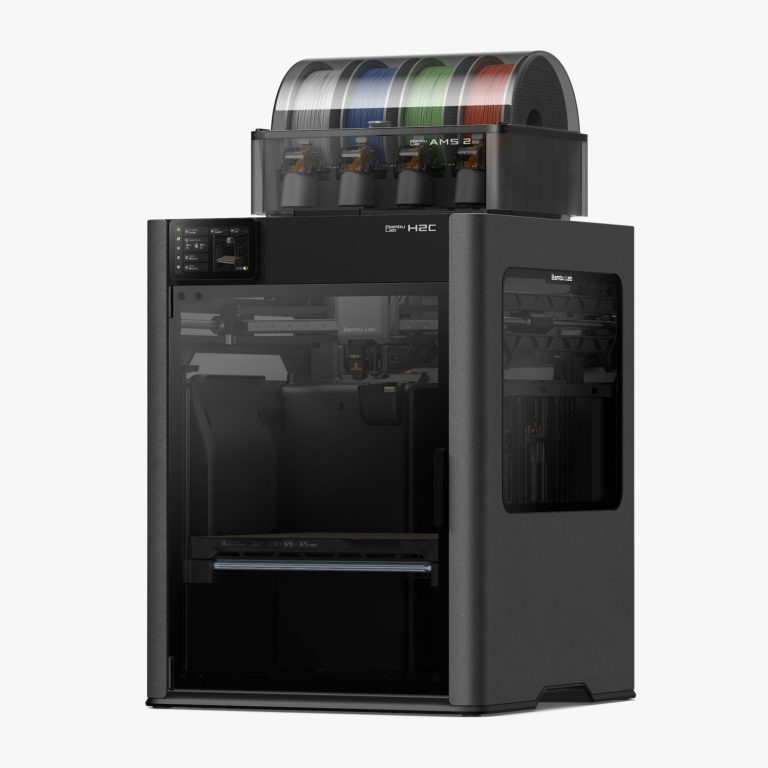
- The P2S, X2D and H2C ship with a hardened steel nozzle. The A1 ships with stainless steel, and its spec page lists carbon fiber as not recommended
- Enclosure
- Needed for nylon carbon fiber. Not needed for PLA-CF. Recommended for PETG-CF
- Easiest first spool
- Bambu PLA-CF, $34.99 for 1 kg with spool when checked November 18, 2026. Not tested by Nick
Nozzle, printer and enclosure rules from Bambu Lab’s wiki and spec pages. Price from Bambu Lab’s US store. All read November 18, 2026.
What is carbon fiber filament?
It’s a base plastic with chopped carbon fiber blended in. The name tells you the base: PLA-CF is PLA, PETG-CF is PETG, and PA-CF or PAHT-CF is nylon. Glass fiber versions, marked GF, work the same way.
Bambu Lab’s carbon fiber explainer says the fibers stay about 0.05 to 0.2 mm long. They don’t melt at printing temperature, which is why these filaments clog more easily than plain ones. Bambu recommends slower speeds and bigger nozzles for them.
Bambu splits them into two groups. PLA-CF and PETG-CF are entry level. They print almost like the plain versions and look great. Nylon and PET based ones are high performance, and they need more from the printer.
Good to know: Bambu’s explainer says adding carbon fiber improves some base plastics a lot and others very little. That’s the whole answer to whether it’s worth it.
Is carbon fiber filament worth it? It depends on the base plastic
Bambu Lab rates its own filaments out of five stars for heat resistance, impact resistance and tensile strength. Put each carbon fiber grade next to its base and the pattern is clear.
| Material | Heat | Impact | Tensile |
|---|---|---|---|
| PLA | 2 | 2 | 3 |
| PLA-CF | 2 | 2 | 4 |
| PETG | 3 | 3 | 2 |
| PETG-CF | 3 | 3 | 3 |
| PA (nylon) | 4 | 3 | 4 |
| PA-CF/GF and PAHT-CF/GF | 5 | 2 | 5 |
| PET-CF/GF | 5 | 1 | 5 |
PLA-CF gains one star, for tensile strength. Heat and impact stay the same as plain PLA. Bambu’s 2023 explainer claims its PLA-CF is more than 30% stiffer than its regular PLA, with better dimensional accuracy. The trade is weaker bonding between layers.
PETG-CF also gains one tensile star. Bambu’s explainer says carbon fiber only slightly improves PETG, but PETG-CF is tougher than PLA-CF and bonds its layers better.
Nylon is where carbon fiber earns its price. Bambu rates its carbon and glass nylons at five stars for heat and tensile strength. Impact drops a star from plain nylon, though. PET-CF goes further. It’s the stiffest here, and Bambu calls it relatively brittle with weaker layer bonding, so it scores one star for impact.
So carbon fiber makes parts stiffer, not tougher. If a part has to take a knock, a stiffer grade can be the wrong choice.
The nozzle: hardened steel or nothing
Bambu Lab’s wiki marks a hardened steel nozzle as required for every carbon and glass fiber grade it lists. It’s blunt about the rest. Don’t use a stainless steel or brass nozzle, because they aren’t hard enough and wear out quickly. Don’t use a 0.2 mm nozzle either, because the clogging risk is extremely high.
For size, Bambu’s first choice is a 0.6 mm hardened steel nozzle, which clogs less. Its second choice is 0.4 mm, for more detail, with 0.15 to 0.3 mm layers and a top speed of about 100 mm/s. Bambu’s own PLA-CF and PETG-CF are the exception. For those, a 0.4 mm hardened nozzle is its first choice. Expect to service the nozzle and extruder gears more often too.
How fast does carbon fiber wear a brass nozzle?
Nobody has a clean number for this, and claims online vary wildly. One independent test is worth knowing. In 2019, Stefan Hermann of CNC Kitchen pushed 360 g of a carbon fiber PETG through a cheap brass nozzle. That’s a bit more than a third of a 1 kg spool.
The hole barely grew. The tip wore away instead, so his first layer got thicker as the nozzle got shorter. Print quality dropped less than he expected, with more stringing, some holes and worse overhangs. He warned it gets much worse once wear reaches the taper inside the tip. A glow in the dark PLA showed no measurable change after 330 g.
That’s one test, with cheap nozzles, so treat it as a single data point. It doesn’t say how long a hardened nozzle lasts.
Before a CF print: Bambu suggests heating the nozzle to 280°C and clearing the inside with an Allen key and a needle, to cut the risk of a clog.
Which printers can print carbon fiber filament?
Check two things on any printer: the nozzle it ships with, and whether it’s enclosed. This table covers Bambu Lab, whose spec pages we read. For any other brand, look for a hardened steel nozzle on its maker’s spec page before you buy a carbon fiber spool.
| Printer | Nozzle as shipped | Max nozzle temp | Carbon fiber on the spec page |
|---|---|---|---|
| Bambu Lab A1 | Stainless steel, 0.4 mm | 300°C | Carbon and glass fiber reinforced polymer listed as not recommended |
| Bambu Lab P2S | Hardened steel, 0.4 mm | 300°C | PLA-CF, PETG-CF, ABS-GF, ASA-CF, PA6-CF, PA6-GF, PAHT-CF, PPA-CF, PET-CF |
| Bambu Lab X2D | Hardened steel, 0.4 mm | 300°C | Main hotend: carbon and glass fiber PLA, PETG, ABS, ASA, PA6, PAHT, PPA and PET. Auxiliary hotend: print PETG-CF, ASA-CF and PA6-CF with caution |
| Bambu Lab H2C | Hardened steel | 350°C | Carbon and glass fiber PLA, PETG, PA, PET, PC, ABS, ASA, PPA and PPS |
The A1 is the one to watch. Its gears are hardened steel, but its nozzle is stainless steel, the kind Bambu’s wiki says not to use for carbon fiber. The X2D and H2C add active chamber heating up to 65°C, by their spec pages.
Do you need an enclosed printer?
Bambu’s printer table splits it by base plastic. PLA-CF and PETG-CF aren’t prone to warping and run on open or enclosed printers. Bambu still recommends an enclosure for PETG-CF, because a cold room can weaken its layers. Nylon, ABS, ASA and PC grades, carbon fiber or not, need an enclosed printer. Bambu’s store page for PAHT-CF says the same: enclosure printer required.
What Nick found printing carbon fiber nylon
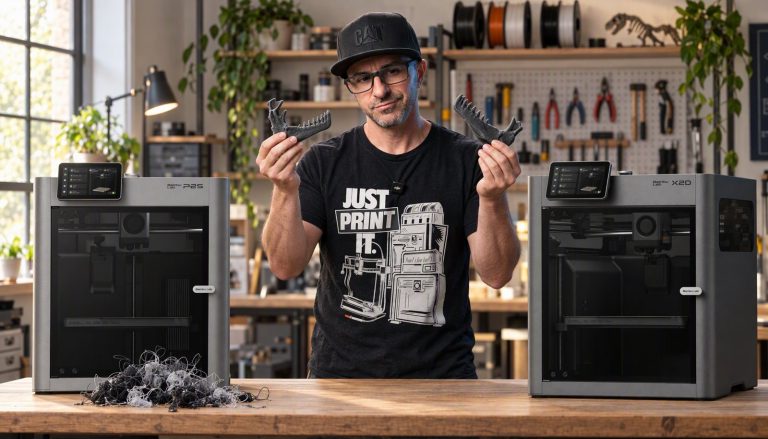
Nick’s X2D video gives a first hand look at carbon fiber nylon, but it’s a support test, not a strength test. In his July 2026 X2D engineering filament test, he printed each filament against two support interfaces, ASA and Bambu’s Support for ABS. Two of them were carbon fiber nylons.
PA12-CF went first. In the video he calls it nylon 12 with carbon fiber that soaks up less moisture. ASA welded itself to the middle of the part, and Support for ABS came off clean. His description links a SUNLU spool for it. PA6-CF flipped the result. For that one the description links both a SUNLU and a Bambu spool, so the brand he ran isn’t confirmed. More on the machine in our Bambu Lab X2D review.
Free filament pairing guideEvery filament from Nick’s X2D test, the support to pair with it and the temperatures, on one page.
Get the free guideCan carbon fiber filament go in the AMS?
Sometimes. Bambu’s wiki warns that rough materials like carbon fiber can eventually grind down the PTFE feed channels inside an AMS, even when a spool loads fine at first. Its AMS notes go further and say to avoid third party fiber filled filaments, because they can wear the tubes and snap. Bambu says its own PLA-CF, PETG-CF and PAHT-CF are tuned for the AMS.
| Filament | AMS, AMS 2 Pro, AMS HT | AMS lite |
|---|---|---|
| Bambu PLA-CF | Yes | Yes |
| Bambu PETG-CF | Yes | No. The store page says not compatible |
| Bambu PAHT-CF | Yes | No |
| Bambu PA6-CF | No, on any AMS | No |
| PET-CF/GF and PPA-CF/GF | No | No |
| Third party CF | Bambu advises against it | Use an external spool |
The AMS lite is the strict one. Bambu’s FAQ says carbon and glass fiber filaments are prone to breaking inside its feeder or damaging it. Bambu PLA-CF is the exception it names.
Drying and print settings for carbon fiber filament
Carbon fiber doesn’t stop the base plastic from soaking up water. Nylon is the worst. Bambu’s explainer puts PA6’s water absorption at about 3%, against about 0.3% for PA12. Its drying table marks drying as required for every nylon and PET carbon grade.
| Filament | Nozzle | Bed, glue stick | Dry before use? | Convection oven |
|---|---|---|---|---|
| PLA-CF | 210 to 240°C | 35 to 65°C | Recommended | 50 to 60°C, 8 h |
| PETG-CF | 240 to 270°C | 60 to 80°C | Recommended | 60 to 65°C, 8 h |
| PA6-CF and PAHT-CF | 260 to 300°C | 90 to 110°C | Required | 75 to 85°C, 8 to 12 h |
| PET-CF | 260 to 300°C | 80 to 100°C | Required | 80°C, 8 to 12 h |
Drying in an AMS works for the entry grades. Bambu gives 45°C for 12 hours for PLA-CF and 65°C for 8 hours for PETG-CF in the AMS 2 Pro. The nylon grades are another matter. The AMS 2 Pro tops out at 65°C, and Bambu warns that may not fully dry them. Its table gives 85°C for 12 hours in an AMS HT for PA6-CF and PAHT-CF.
Need a dryer that runs hotter? Compare them in our best filament dryers guide, or see current prices on the filament dryer deals page.
When carbon fiber filament isn’t worth it
- Decorative PLA prints. PLA-CF keeps PLA’s heat rating. Bambu says PLA isn’t recommended at about 50°C or higher, and carbon fiber doesn’t change that star.
- Parts that take knocks. No carbon fiber grade in Bambu’s table gains an impact star, and the nylon and PET ones lose one or two.
- A brass or stainless nozzle you don’t want to change. Bambu’s rule is hardened steel, every time.
- An AMS lite and third party spools. Bambu’s FAQ says to feed them from an external spool.
- An open printer and nylon CF. Bambu lists those grades for enclosed printers only.
For most everyday parts, plain PLA or PETG does the job. If you’re still choosing between them, start with PLA vs PETG vs ABS. And if a part needs to flex rather than snap, Nick reached for glass fiber nylon in his X2D video. He said PA6-GF “doesn’t snap under force, and it bends to take the pressure” (3:12).
Which carbon fiber filament to buy
These are picks by job, from the makers’ own pages. Prices are the official stores’ own, read on November 18, 2026. Nobody here has run these spools head to head, so there’s no single winner.
Bambu Lab PLA-CF
Best first carbon fiber spool, for a matte finish and stiffer small parts. Not tested by Nick.
- Bambu’s store lists it as compatible with all AMS series, the AMS lite included
- 0.4 mm hardened steel nozzle is Bambu’s first choice for it
- Store cautions: 0.2 mm nozzle not compatible, stainless steel not recommended
- Refill without spool: $31.99 when checked November 18, 2026
$34.99 for 1 kg with spool, list price checked November 18, 2026
Check price at Bambu LabBambu Lab PETG-CF
For tougher layers than PLA-CF and outdoor use, by Bambu’s account. Not tested by Nick.
- Bambu says it’s tougher than PLA-CF with better layer bonding, but less stiff
- Works in the AMS, AMS 2 Pro and AMS HT. Not the AMS lite
- An enclosed printer is recommended
- Refill without spool: $31.99 when checked November 18, 2026
$34.99 for 1 kg with spool, list price checked November 18, 2026
Check price at Bambu LabSUNLU PETG-CF
A lower cost PETG-CF for any printer with a hardened nozzle. Not tested by Nick.
- A third party CF, so on a Bambu printer feed it from an external spool, not the AMS
- SUNLU’s own print settings weren’t read for this guide. Check them on its store page
- Price from the Planet 3DP price tracker, which reads SUNLU’s store
$22.99 list for 1 kg (on sale for $19.99), list price checked November 18, 2026
Check price at SUNLUBambu Lab PAHT-CF
For stiff, heat resistant engineering parts on an enclosed printer. Not tested by Nick.
- Bambu’s store: 0.6 mm nozzle recommended, enclosure printer required
- Works in the AMS, AMS 2 Pro and AMS HT. Not the AMS lite
- Drying required. 85°C for 12 h in an AMS HT
- The 0.5 kg spool was out of stock when checked
$94.99 list for 1 kg with spool (on sale for $56.99), list price checked November 18, 2026
Check price at Bambu LabSUNLU PA12-CF
The carbon fiber nylon Nick printed in his X2D support test. Not reviewed for strength.
- Support for ABS released clean from it in Nick’s test
- Nylon 12 soaks up less water than nylon 6, by Bambu’s explainer
- Not on our price tracker yet, so check the current price on SUNLU’s store
Two more worth knowing. Bambu Lab PA6-CF was out of stock in both sizes when checked, at $79.99 list for 1 kg (on sale for $47.99). Flashforge PLA-CF sits on our filament deals page at $25.99 for 1 kg, checked November 18, 2026. See the Flashforge listing for the maker.
Carbon fiber filament questions
Is carbon fiber filament worth it?
It depends on the base plastic. In Bambu’s ratings, PLA-CF and PETG-CF each gain one star for tensile strength and nothing for heat or impact. Carbon fiber nylon reaches five stars for heat and tensile strength but needs an enclosed printer and drying.
Do you need a hardened steel nozzle for carbon fiber filament?
Yes. Bambu Lab’s wiki marks a hardened steel nozzle as required for every carbon fiber grade it lists and says not to use brass or stainless steel, or a 0.2 mm nozzle.
Can the Bambu Lab A1 print carbon fiber filament?
As shipped, the A1 has a stainless steel nozzle, and its spec page lists carbon and glass fiber reinforced polymers as not recommended. The P2S, X2D and H2C ship with hardened steel nozzles.
Can carbon fiber filament go in the AMS?
Bambu PLA-CF works in every AMS, the AMS lite included. Bambu PETG-CF and PAHT-CF work in the AMS, AMS 2 Pro and AMS HT but not the AMS lite. Bambu advises against third party fiber filled filaments in the AMS because they can wear the PTFE tubes.
Does carbon fiber filament need drying?
Bambu recommends drying PLA-CF and PETG-CF and requires it for nylon and PET carbon grades. Its convection oven settings run from 50 to 60°C for 8 hours for PLA-CF up to 75 to 85°C for 8 to 12 hours for PA6-CF and PAHT-CF.
How fast does carbon fiber wear a brass nozzle?
In one 2019 test by CNC Kitchen, 360 g of carbon fiber PETG wore away the tip of a cheap brass nozzle and raised the first layer height, while the hole barely grew. It’s one test, and it doesn’t say how long a hardened nozzle lasts.
- Bambu Lab wiki: filament guide material table (checked November 18, 2026)
- Bambu Lab wiki: Filament Drying Guide (checked November 18, 2026)
- Bambu Lab wiki: Notes for AMS (checked November 18, 2026)
- Bambu Lab wiki: AMS lite FAQ (checked November 18, 2026)
- Bambu Lab: A1 technical specifications (checked November 18, 2026)
- Bambu Lab: P2S technical specifications (checked November 18, 2026)
- Bambu Lab: X2D technical specifications (checked November 18, 2026)
- Bambu Lab: H2C technical specifications (checked November 18, 2026)
- Bambu Lab blog: Bambu Carbon Fiber Filaments (May 2023) (checked November 18, 2026)
- CNC Kitchen: How much abrasive filaments damage your nozzle (September 2019) (checked November 18, 2026)
- Bambu Lab US store: PLA-CF, price and cautions (checked November 18, 2026)
- Bambu Lab US store: PETG-CF, price and cautions (checked November 18, 2026)
- Bambu Lab US store: PAHT-CF, price and cautions (checked November 18, 2026)
- Bambu Lab US store: PA6-CF, price and stock (checked November 18, 2026)
- SUNLU store: PETG-CF (price via the Planet 3DP price tracker) (checked November 18, 2026)
- Planet 3DP video: I Tested Every Engineering Filament on the Bambu X2D (July 2026) (checked November 18, 2026)

Host of Planet 3DP. He printed PA12-CF and PA6-CF carbon fiber nylons on his Bambu X2D in his July 2026 engineering filament test. Planet 3DP on YouTube.
Last checked November 18, 2026.