

Some links on this page are affiliate links. If you buy through one, Planet 3DP earns a small commission at no extra cost to you. It never changes what we recommend. How this works.
How to dry filament comes down to two numbers: a temperature your filament can take without softening, and enough hours at it. Bambu Lab’s own chart puts PLA Basic at 50°C for 8 hours in a convection oven and PETG at 60 to 65°C. The right numbers also depend on what you dry it in. An AMS, a printer’s heatbed, an oven and a standalone dryer each get their own settings.
So this guide starts from what you own. Pick your method, use the maker’s figure for it, then store the spool so it stays dry. Bambu Lab has changed its drying page since late October, adding the heatbed method and the AMS 3H, and every figure here was read from it on November 13, 2026.
Wondering if you need a dryer at all? Our best filament dryers guide answers that and compares the boxes. For every material in one place, see our complete filament guide.
The short answer
- AMS 2 Pro
- Up to 65°C. Fine for PLA (45°C, 12 h) and PETG (65°C, 12 h). Bambu says hotter filament may not fully dry in it.
- AMS HT or AMS 3H
- Up to 85°C. ABS and ASA at 80°C for 8 h, TPU at 75°C for 18 h.
- Enclosed printer heatbed
- PLA Basic at 60 to 70°C for 12 h, flipped every 6 h. Open frame printers can’t do this.
- Convection oven
- PLA Basic at 50°C for 8 h. Check it with a separate thermometer.
- Standalone dryer
- Use the spool label’s temperature, as long as the box can reach it.
- Afterwards
- A sealed box with desiccant, below 20% humidity.
Temperatures and times from Bambu Lab’s drying guide for its own filament, read November 13, 2026. Not tested by Nick, except that he dries his spools in a SUNLU S4.
How to tell your filament is wet
All filament takes on water from the air. Bambu Lab explains what happens next. The water turns to steam in the hot nozzle, the melt expands and the flow goes uneven.
You’ll see it in the print first. Bambu lists stringing, oozing, rough surfaces, holes, weak layer bonds and lower strength. Bad cases clog the nozzle or stop the feed. Prusa adds blobs, bubbling and smoke during extrusion. You may also hear popping from the nozzle.
Bambu suggests drying before you print in five cases:
- The spool has been open a long time, above all in a damp room.
- You can’t be sure it was sealed, or that its desiccant still works.
- You see popping, bubbles, stringing, rough walls, holes or weak layers.
- The part needs a clean look, accurate size or full strength.
- It’s a filament that soaks up water fast, like TPU, PETG, PLA Wood, PC, PVA or carbon and glass fibre blends.
Seeing the problem but not sure it’s moisture? Our wet filament fix sits next to the other common print faults, so you can rule them out.
How to dry filament: pick your method
Bambu Lab names three methods. Prusa adds a standalone dryer and a food dehydrator. Here’s what each one needs.
| Method | Top heat | Who can use it | Watch out for |
|---|---|---|---|
| AMS 2 Pro | 65°C | Bambu owners with one plugged into power | ABS, ASA, PC, TPU and nylon may not fully dry |
| AMS HT or AMS 3H | 85°C | Bambu owners with one plugged into power | PPA-CF and PPS-CF may not fully dry |
| Printer heatbed | Up to 120°C in Bambu’s table | Enclosed printers only | Spool heat rating. Flip every 6 hours |
| Convection oven | Depends on the oven | Anyone with an oven | Prusa warns home ovens aren’t precise |
| Standalone dryer | Depends on the box | Any printer | Check its top heat against your filament |
| Food dehydrator | Low, by Prusa’s account | Any printer | Trays out, spool in |
How to dry filament in a Bambu AMS
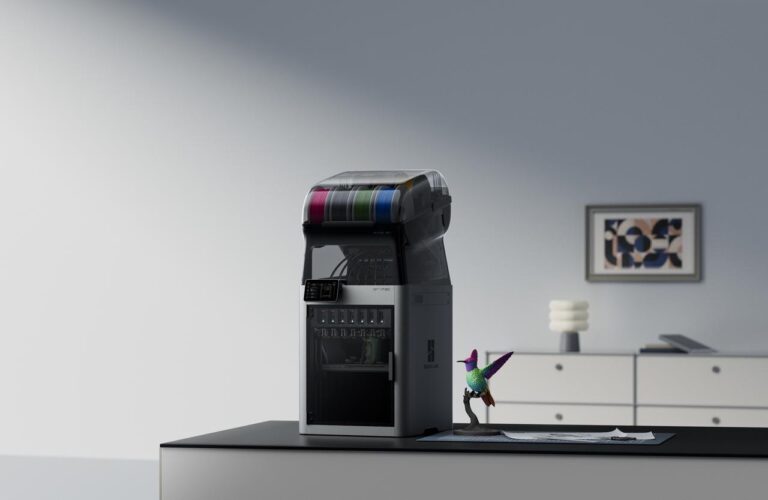
Three Bambu units dry filament: the AMS 2 Pro, the Bambu Lab AMS HT and the AMS 3H, the filament unit that comes with the Bambu Lab H3C. They differ on heat. The AMS 2 Pro tops out at 65°C. The AMS HT and AMS 3H reach 85°C.
1. Check the filament can be dried in it
The AMS 2 Pro suits anything with a drying temperature of 65°C or less, like PLA and PETG. Above that, Bambu says it may not dry the spool completely and points you to the heatbed, an AMS HT, an AMS 3H or an oven. The AMS HT and AMS 3H dry everything in Bambu’s table except PPA-CF and PPS-CF.
2. Plug it into power
None of them dries without power. The AMS HT always needs its own standard power cable, because drying draws more than the printer can supply. The AMS 3H needs an external power supply too.
The AMS 2 Pro depends on the printer. On the X1 series, the P1 series and the A2L, each unit needs its own power adapter. The H2 series, the P2S and the X2D can power one AMS 2 Pro for drying without one. Bambu adds a catch: if a P2S or X2D dries that way, it can’t heat the bed or hotend, move its axes or load filament until it’s done. Any extra units need adapters, bought separately. Bambu’s official adapter is 24V 4A, and it warns that a third party adapter can damage the unit.
3. Take out anything that can’t take the heat
Drying ABS or PETG runs hotter than PLA and TPU can stand. Bambu says to remove PLA and TPU from the AMS before you start, or they can soften and deform. When you’re drying PLA, other filaments can stay in.
4. Let the spool turn
Bambu recommends rotating mode. Pull the filament end out of the feed port and clip it to the side of the spool, and the spool turns 30° every 5 minutes for even heat. Static mode leaves the end in the feed port. Bambu says it isn’t suitable for PLA, PVA, Support for PLA/PETG or TPU, which can stick together or deform. On the H2D, firmware 01.03.00.00 and later can dry PLA and TPU without rotation.
5. Start it from the screen or your phone
On the printer, pick the AMS, the filament type, the temperature and the time. Remote start from Bambu Studio or Bambu Handy needs recent firmware: H2D 01.03.00.00, H2S 01.02.00.00, P2S 01.02.00.00, X2D 01.01.00.00 or A2L 01.01.00.00. Bambu says the P1S, P1P, X1C, A1 and A1 mini aren’t supported yet.
Printing while it dries? The AMS lowers its own heat once a print starts, to no more than the softest filament inside can take. Bambu’s examples: PETG drying while PLA prints drops to 45°C, and ABS drying while PETG prints drops to 55°C.
When the timer ends, wait 5 to 10 minutes until the spool is no longer hot to the touch. Then seal it away with fresh desiccant and use it soon. Don’t worry if the AMS humidity number climbs afterwards. Bambu says that’s the chamber cooling, not new moisture.
The AMS HT was 119 dollars for one unit at Bambu Lab’s US store (139 list), checked November 13, 2026. Check the current price of the AMS 2 Pro and the H3C on Bambu’s store.
How to dry filament on your printer’s heatbed
No dryer? An enclosed printer can do the job with its bed. Bambu’s table gives heatbed figures for its H series, X series, P1S and P2S. The Bambu Lab P1P, A1, A2L and A1 mini are open frame and can’t.
- Check the spool. Bambu shows a low temperature spool rated to 70°C and a high temperature spool rated to 90°C. Some third party and printed spools deform.
- Find a cover. The filament’s own cardboard box works, or a drying cover printed in a heat tolerant filament like PC or PA-CF. Bambu points to its Bambu Filament Drying Cover model on MakerWorld.
- Unload the filament from the toolhead, so it can’t soften in the extruder.
- Clear the plate, home the printer and lower the bed.
- Put the spool, or the covered spool, on the bed.
- Set the filament type, bed temperature and time, then start.
- Flip the spool every 6 hours, wearing gloves.
- When the time’s up, set the bed to 0°C, wait 5 to 10 minutes, then seal the spool away.
The P1S has no drying screen, so you lower the bed, set the temperature and keep time yourself. Owners of the P2S, X2D, X1 Carbon, H2D and H2S use the figures in the table further down.
How to dry filament in an oven
Bambu’s oven figures are for a convection oven: PLA Basic at 50°C, PETG at 60 to 65°C, and ABS, ASA and PC at 75 to 85°C, each for 8 hours.
Prusa is more cautious about kitchen ovens. Their temperature isn’t precise, and a swing that doesn’t hurt food can damage filament, PLA above all. Many can’t be set low enough at all. So Prusa says to keep a separate thermometer in there and correct the dial. It also warns against going over the drying temperature, or the filament softens and sticks together. Stick to the time as well, because Prusa says overdrying is a risk too.
Mind the spool. Prusament spools made from October 2025 are rated to 90°C. An older black Prusament spool can come loose above 45°C unless you add an M4x65 screw. Older grey ones are glued and take up to 90°C.
A food dehydrator is the other route Prusa describes. Take the trays out and stand the spool inside. Prusa notes most run only at low temperatures, so check yours against the filament first.
Not tested by Nick. The oven, heatbed and AMS steps on this page come from Bambu Lab and Prusa. Nick’s own spools go in his SUNLU dryer.
How to use a filament dryer
A standalone dryer is a heated box you can usually print from. Prusa’s one rule for them is to check the box’s top temperature against your filament’s drying temperature before you buy.
Nick dries his spools in a SUNLU FilaDryer S4. It’s in the filament gear list of his tools video. Our tracker lists it at four spools, up to 70°C, with humidity control, and it can feed a printer while it dries. That 70°C covers Bambu’s PLA and PETG figures. ABS, ASA, PC and nylon want 75 to 85°C, so it’s short for those.
PPA-CF and PPS-CF go further still, at 100 to 140°C in Bambu’s oven column. Of the 13 dryers on our deals page, the SUNLU FilaDryer E2 runs hottest, at up to 110°C. That pick comes from its specs, not from a test.
The S4 was 116.99 dollars at SUNLU’s store (139.99 list), checked November 13, 2026. The E2 was 249.99 dollars at SUNLU’s store (349.99 list), checked November 13, 2026. SUNLU sends Nick filament to test.
Buying direct from SUNLU? Use code MRNGB2VN5D at checkout for a discount.
Every other box, with live prices, is on our filament dryer deals page.
Filament drying temperatures and times
| Bambu filament | AMS 2 Pro | AMS HT | AMS 3H | Convection oven | Heatbed (H, X, P1S, P2S) |
|---|---|---|---|---|---|
| PLA Basic and Matte | 45°C, 12 h | 45°C, 12 h | 55°C, 12 h | 50°C, 8 h | 60 to 70°C, 12 h |
| PLA Silk | 45°C, 12 h | 45°C, 12 h | 55°C, 12 h | 55°C, 8 h | 65 to 75°C, 12 h |
| PETG and PETG-CF | 65°C, 12 h | 65°C, 12 h | 65°C, 12 h | 60 to 65°C, 8 h | 75 to 85°C, 12 h |
| ABS and ASA | 65°C, 12 h (may not fully dry) | 80°C, 8 h | 80°C, 8 h | 75 to 85°C, 8 h | 90 to 100°C, 12 h |
| TPU 85A and 90A | 65°C, 12 h (may not fully dry) | 75°C, 18 h | 75°C, 18 h | 70°C, 8 h | 90°C, 16 h |
| TPU 95A HF and TPU for AMS | 65°C, 12 h (may not fully dry) | 75°C, 18 h | 75°C, 18 h | 70°C, 8 h | 80 to 90°C, 12 h |
| PC | 65°C, 12 h (may not fully dry) | 80°C, 8 h | 80°C, 8 h | 75 to 85°C, 8 h | 90 to 100°C, 12 h |
| PVA | 65°C, 12 h (may not fully dry) | 85°C, 18 h | 85°C, 18 h | 75 to 85°C, 8 to 12 h | 90 to 100°C, 12 h |
| PA6-CF, PAHT-CF and GF blends | 65°C, 12 h (may not fully dry) | 85°C, 12 h | 85°C, 12 h | 75 to 85°C, 8 to 12 h | 90 to 100°C, 12 h |
| PPA-CF and PPS-CF | 65°C, 12 h (may not fully dry) | 85°C, 12 h (may not fully dry) | 85°C, 12 h (may not fully dry) | 100 to 140°C, 8 to 12 h | 110 to 120°C, 10 to 12 h |
Bambu and Prusa don’t agree, so follow the label
The two makers publish different numbers for the same material. Prusa runs cooler and shorter. Each table covers that maker’s own filament, so neither is wrong.
| Material | Bambu Lab, convection oven | Prusa, Prusament |
|---|---|---|
| PLA | 50°C, 8 h (PLA Basic) | 45°C, 6 h |
| PETG | 60 to 65°C, 8 h | 55°C, 6 h |
| TPU | 70°C, 8 h | 60°C, 4 to 6 h |
| ASA | 75 to 85°C, 8 h | 80°C, 4 h |
| PC | 75 to 85°C, 8 h | 85°C, 5 h (PC Blend) |
| Nylon carbon fibre | 75 to 85°C, 8 to 12 h (PA6-CF) | 90°C, 6 h (PA11 CF) |
The tie breaker: if your spool’s label or the maker’s page gives a drying temperature, use that. Neither table covers another brand’s PLA+, silk blends or nylon.
How to store filament so it stays dry
Drying only buys you time. Bambu says open air usually sits at 45 to 65% humidity, higher in wet weather. At about 55%, a freshly dried spool takes back enough water to hurt print quality within 2 to 12 hours. Even at 20%, it stays dry for only about 2 to 7 days.
Here’s the setup Bambu and Prusa describe:
- A sealed box. Bambu suggests a 4 litre one, and the same box can feed TPU to the printer if you fit rollers inside.
- Enough desiccant, checked often and replaced when it’s spent.
- A thermo hygrometer in the box for nylon types like PA, PA-CF and PAHT-CF. Aim below 20%.
- Or a vacuum bag with desiccant inside, which Prusa suggests. Any bag that fits a spool will do.
Short on space? Prusa says to seal the thirsty ones first. PLA doesn’t change much when it takes on water, and polyamide changes a lot.
For the AMS, Bambu wants its own silica gel. Its indicator beads change colour as they soak up water. Spent desiccant looks dark green and fresh looks yellow, so swap it when it turns. Avoid calcium chloride desiccant. Bambu warns that once it’s saturated it can release water and damage the electronics.
How often should you dry? Bambu’s AMS FAQ says nylon, PAHT, PET-CF and TPU must be dried before printing. PLA and PETG generally don’t need frequent drying if they’re kept sealed.
Does filament go bad? What the makers say
Neither Bambu Lab nor Prusa gives filament an expiry date on the pages we read. Shelf lives you’ll find quoted elsewhere don’t come from either maker.
What both makers do describe is moisture. Bambu says every filament absorbs it, more so in damp air and the longer it’s open. Its fix is to dry the spool before printing and keep it sealed afterwards. Prusa says some filaments are far more sensitive than others.
Heat is the other way to spoil a spool. Prusa warns that going over the drying temperature makes filament soften and stick together, and that drying too long is a mistake too.
So if an old spool prints badly, Bambu’s advice applies: when you can’t confirm it’s dry, dry it first. Then print a test part and compare.
Drying mistakes the makers warn about
| Mistake | What the maker says |
|---|---|
| Drying ABS or PC in an AMS 2 Pro | Bambu: its 65°C may not fully dry them |
| Leaving PLA or TPU in the AMS while drying PETG or ABS | Bambu: they can soften and deform |
| Static drying for PLA, PVA or TPU | Bambu: they can stick together or deform |
| Heatbed drying on an open frame printer | Bambu: the P1P, A1, A2L and A1 mini can’t |
| Trusting a kitchen oven dial | Prusa: use a separate thermometer |
| Heating an old black Prusament spool above 45°C | Prusa: add an M4x65 screw first |
| Calcium chloride in the AMS | Bambu: it can release water and damage electronics |
Nick's tool sheet The S4 is on the one page list from his tools video, with everything else on his bench.
Get the free sheetFilament drying questions
How do I dry filament without a dryer?
Use an enclosed printer’s heatbed or a convection oven. Bambu gives PLA Basic 60 to 70°C for 12 hours on the heatbed, flipped every 6 hours, or 50°C for 8 hours in a convection oven. Prusa says to check a home oven with a separate thermometer.
What temperature should I dry PLA at?
Bambu’s figure for PLA Basic is 50°C for 8 hours in a convection oven, or 45°C for 12 hours in an AMS 2 Pro or AMS HT. Prusa’s figure for Prusament PLA is 45°C for 6 hours. Follow your spool label if it gives one.
Can the AMS 2 Pro dry ABS?
Bambu lists 65°C for 12 hours for ABS in the AMS 2 Pro and flags that it may not fully dry it. It suggests an AMS HT or AMS 3H at 80°C for 8 hours, the heatbed or an oven.
Can I print while the AMS is drying?
Yes. Bambu says the AMS lowers its drying heat to suit the softest filament inside. PETG drying while PLA prints runs at 45°C.
How long does dried filament stay dry?
Bambu says about 2 to 7 days at 20% humidity. At about 55%, a dried spool takes back enough water to hurt prints within 2 to 12 hours.
Does filament go bad?
Neither Bambu Lab nor Prusa publishes an expiry date on the pages we read. Both treat moisture as the problem, solved by drying and sealed storage.
Which filament dryer does Nick use?
A SUNLU FilaDryer S4. It holds four spools and heats to 70°C. It was 116.99 dollars at SUNLU’s store on November 13, 2026.
- Bambu Lab Wiki: Filament Drying Recommendations, methods, steps and parameter table (checked November 13, 2026)
- Bambu Lab Wiki: Sealed Box, storage humidity (checked November 13, 2026)
- Bambu Lab Wiki: AMS Humidity Detection Function, desiccant and FAQ (checked November 13, 2026)
- Prusa Knowledge Base: Drying filament (checked November 13, 2026)
- Planet 3DP video: New 3D Printer? Don't Start Without These Tools (April 2026), description (checked November 13, 2026)
- Planet 3DP price tracker: SUNLU S4, SUNLU E2 and AMS HT store prices (checked November 13, 2026)
- SUNLU store: FilaDryer S4 (checked November 13, 2026)
- SUNLU store: FilaDryer E2 (checked November 13, 2026)
- Bambu Lab US store: AMS HT (checked November 13, 2026)
- Planet 3DP directory: Bambu Lab H3C, with the AMS 3H (checked November 13, 2026)

Host of Planet 3DP. 3D printing for over four years, with tens of thousands of print hours on Bambu Lab, Anycubic, Creality, Elegoo and Snapmaker machines. The SUNLU S4 on this page is the dryer he uses. Planet 3DP on YouTube.
Last checked November 13, 2026.